
How Craps Really Works: Dice Probability, Bets, and Why Myths Persist
Craps is one of the most misunderstood games in the casino—not because it is especially complex, but because it combines uneven probability, physical interaction, and extreme short-term volatility in a way that overwhelms intuition.
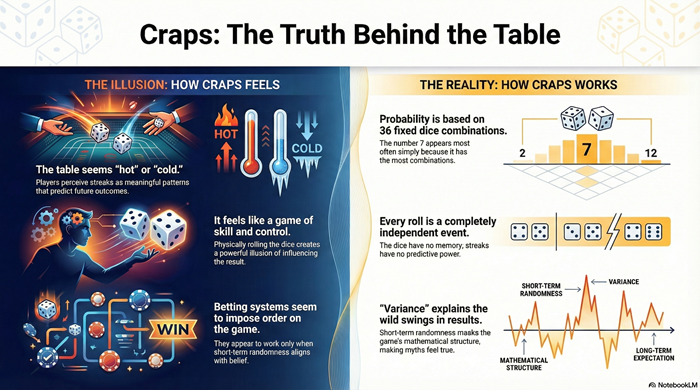
To many players, craps feels alive. Tables seem hot or cold. Shooters appear skilled. Streaks feel meaningful. Systems feel logical. None of these impressions are unusual—and none of them accurately describe how the game works.
This guide exists to separate mechanism from perception.
Craps is not driven by momentum, timing, or belief. It is driven by two dice, fixed probabilities, predefined payouts, and statistical variance. Every roll is independent. Every outcome follows the same mathematical structure. The casino’s advantage is not hidden or reactive—it is built into how the game is designed.
What confuses players is not deception. It is the gap between how probability behaves in theory and how randomness feels in real experience. That gap is where myths are born.
Craps Is a Dice Game Before It Is a Betting Game
Before craps is a table, a crowd, or a maze of betting options, it is something far simpler: a game driven entirely by two dice.
Every roll produces one outcome. Everything else—table markings, terminology, and rituals—exists on top of that foundation.
Probability in craps is determined by combinations, not by intention or behavior. Once the dice stop, the outcome is fixed, and nothing from the past carries forward.
The table does not represent multiple games. It represents multiple ways of referencing the same roll.
Related deep dive:
What Is Craps? Dice Mechanics, Outcomes, and Why the Table Looks So Complicated
Dice Probability Is Uneven—and That Shapes Everything
Two fair dice create 36 equally likely combinations, but those combinations do not produce totals evenly.
Some totals can be formed in many ways. Others can be formed in very few. This is why certain numbers dominate play while others feel rare or dramatic.
Seven appears most often not because it is special, but because it has the greatest number of valid combinations. This uneven distribution shapes player experience, table rules, and emotional response.
Probability governs long-term frequency, not short-term order. High-frequency outcomes are not “due,” and low-frequency outcomes are not scheduled to appear.
Related deep dive:
Craps Dice Probability Explained: Why 7 Appears More Often Than Other Numbers
House Edge in Craps Is Structural, Not Tactical
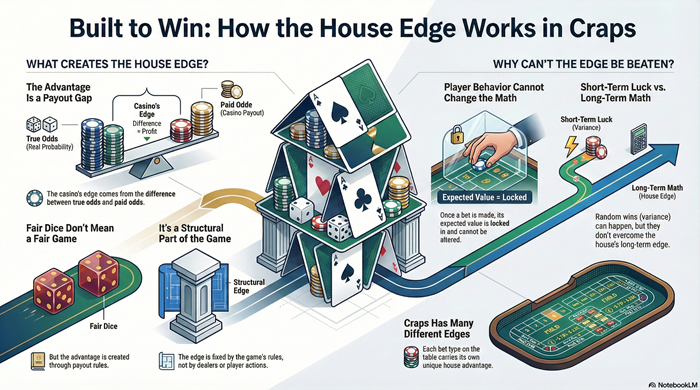
The casino advantage in craps does not come from the dice or player behavior. It comes from how payouts are structured relative to probability.
House edge measures long-term expectation. It does not predict session results, streaks, or short-term outcomes.
Because craps allows many different contracts tied to the same dice, there is no single house edge for the entire game. Each contract has its own expectation, fixed at the moment it exists.
Behavior cannot alter this structure. Timing, reactions, or belief do not change probability or payouts.
Related deep dive:
House Edge in Craps: How the Casino Advantage Is Built Into the Game
Dice Rolls in Craps Are Independent
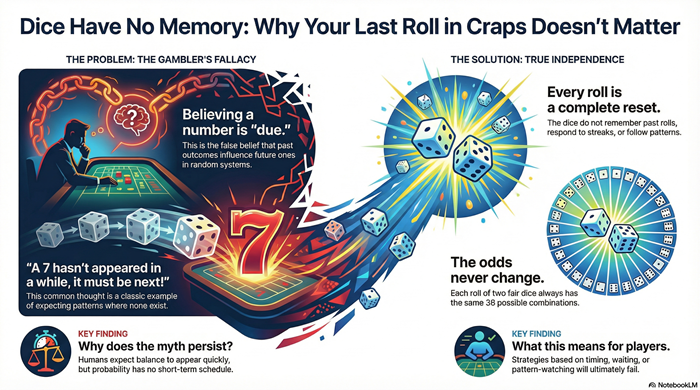
Each roll of the dice is a complete reset.
Independence means:
- previous outcomes do not influence future ones
- probabilities remain unchanged on every roll
- streaks have no predictive power
Random processes naturally produce clustering, runs, and gaps. These do not violate independence—they are expected outcomes of it.
The belief that outcomes must “even out” in the short term is known as the gambler’s fallacy. Balance exists only over very large samples, not on a schedule players experience.
Related deep dive:
Are Dice Rolls Independent in Craps? Why Previous Rolls Don’t Matter
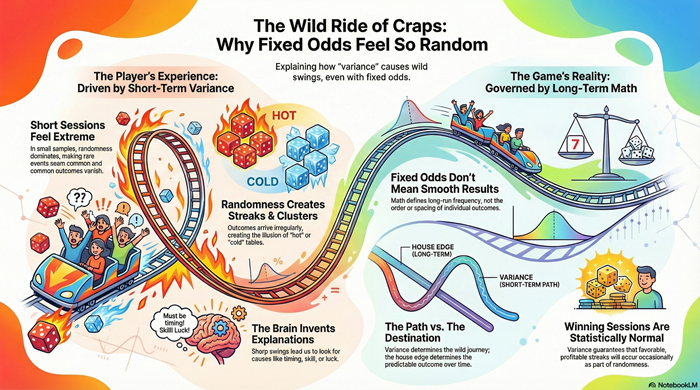
Variance Explains Why Craps Feels So Wild
Variance describes how outcomes are distributed over time.
Probability explains averages.
House edge explains expectation.
Variance explains experience.
In short sessions:
- randomness dominates
- results feel extreme
- rare events can appear quickly
Variance masks structure in the short run, making wins feel earned and losses feel situational—even when nothing fundamental has changed.
Variance does not contradict probability. It expresses it unevenly.
Related deep dive:
Variance in Craps: Why Results Swing Wildly Even When Odds Are Fixed
Why Craps Feels Like a Skill Game (But Isn’t)
Craps feels different because players throw the dice, make visible choices, and experience outcomes socially.
Physical interaction, public outcomes, and table complexity combine to create the illusion of control.
Rituals and habits reduce anxiety during variance, but they do not influence probability. Choices select between predefined contracts—they do not change future outcomes.
Structure always dominates behavior.
Related deep dive:
Why Craps Looks Like a Skill Game (But Isn’t): Complexity, Rituals, and Control Illusions
Why Craps Systems Fail—Even When They Seem to Work
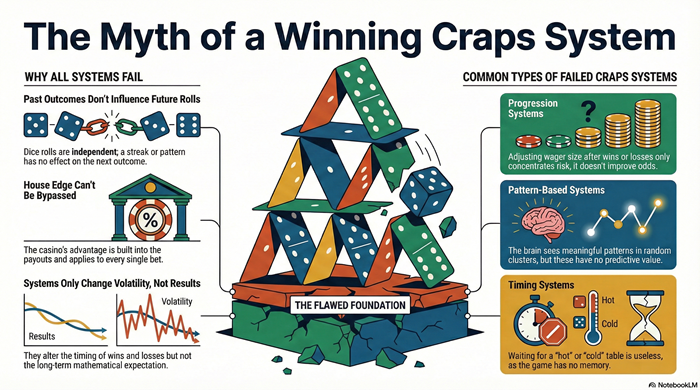
Craps systems attempt to impose order on randomness.
Progressions change volatility, not expectation.
Pattern-based systems react to the past, which has no predictive power.
Timing systems assume conditions that do not exist.
When systems appear to work, it is because variance temporarily aligns with belief. When they fail, execution is blamed instead of structure.
The game does not adapt. Expectation remains fixed.
Related deep dive:
Common Craps Systems Explained—and Why They Fail Mathematically
Why Craps Myths Persist—Even When the Math Is Clear
Craps myths are not foolish. They are human.
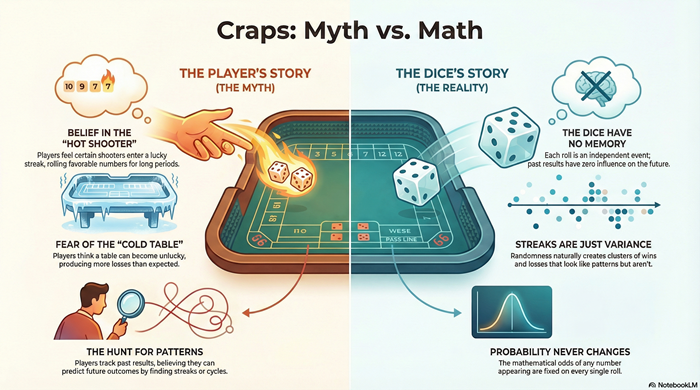
Streaks, reversals, and rare events demand explanation. Myths provide narratives where math feels unsatisfying.
Hot shooters, cold tables, and pattern watching all assume memory where none exists. Variance supplies just enough confirmation to keep belief alive.
Understanding craps does not remove emotion or enjoyment. It removes false explanations.
Related deep dive:
Myths About Craps That Refuse to Die: Hot Shooters, Cold Tables, Pattern Watching
Final Synthesis
Craps is not chaotic.
It is not adaptive.
It is not responsive to belief.
It is a fixed probabilistic system that feels complex because humans are not built to intuitively process randomness.
Once that is understood, everything else—systems, rituals, and myths—falls into place.