
House Edge in Craps: How the Casino Advantage Is Built Into the Game
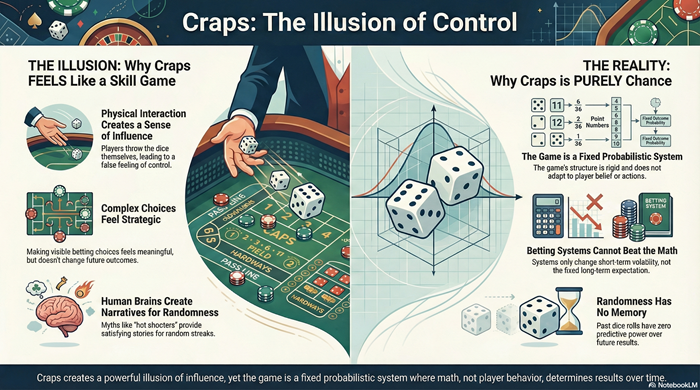
This article is part of our complete guide on How Craps Really Works: Dice Probability, Bets, and Why Myths Persist , which explains craps probability, house edge, variance, and why common myths fail.
House Edge Is a Property of Structure
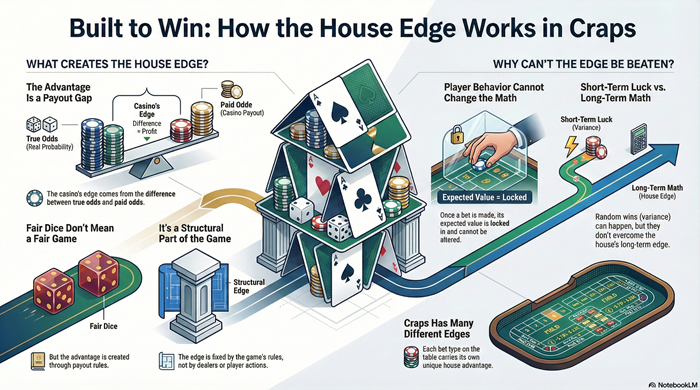
The casino advantage in craps is not created by the dice, the dealer, or player behavior. It exists because of how outcomes are paid relative to how often they occur.
This difference between true probability and payout is known as the house edge.
House edge is not tactical. It is structural.
What House Edge Actually Measures
House edge does not describe what will happen in a single roll or even a single session.
It measures:
- long-term expected value
- per unit wagered
- over a very large number of trials
A house edge of any size applies equally to every unit wagered, regardless of order, timing, or behavior.
Why Fair Dice Can Still Produce an Unfair Game
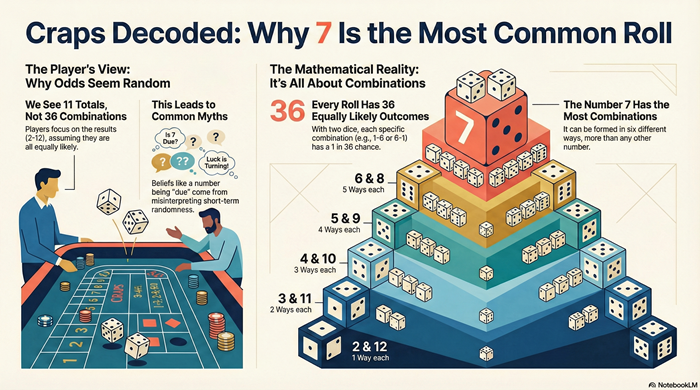
The dice used in craps are assumed to be fair. Each of the 36 possible combinations is equally likely on every roll.
Fair inputs, however, do not guarantee fair outcomes.
The casino advantage is created after probability is resolved—through payout design.
Payouts, Not Probability, Create the Edge
True Odds vs Paid Odds
If a game paid exactly according to probability, the expected value would be zero.
In craps, payouts are set slightly below true odds.
That difference is small, but persistent.
Over time, it accumulates into a reliable advantage.
Why This Is Not Hidden
The house edge in craps is not secret.
It exists openly in the relationship between:
- how often an outcome occurs
- how much is paid when it does
The math is fixed before the roll happens.
One Game, Many House Edges
Craps allows many different contracts to be tied to the same dice.
Each contract defines:
- which outcomes qualify
- how often they occur
- what payout is offered
Because of this, there is no single house edge for craps as a whole.
Each contract carries its own expectation, locked in at the moment it exists.
Why House Edge Does Not Feel Immediate
House edge does not act like a fee charged on every roll.
Instead:
- wins still occur
- streaks still appear
- short-term outcomes fluctuate widely
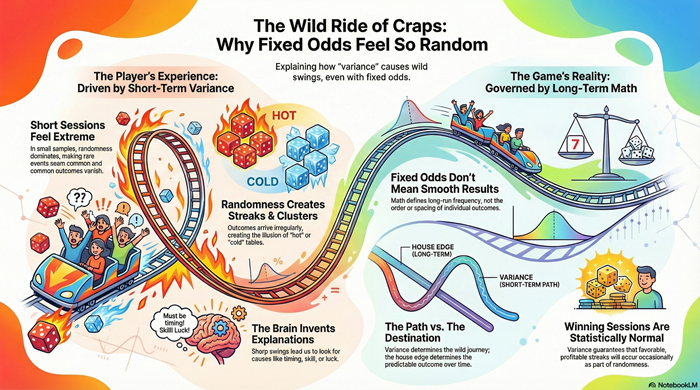
Variance masks the edge in the short run.
This is why players can experience winning sessions even in negative-expectation games.
House Edge vs Variance
Why They Are Often Confused
Variance dominates short-term experience, while house edge governs long-term results.
This leads players to misattribute outcomes:
- wins are credited to decisions
- losses are blamed on timing
Neither explanation changes expectation.
What House Edge Guarantees (and What It Doesn’t)
House edge guarantees:
- the casino benefits over enough trials
It does not guarantee:
- session outcomes
- smooth losses
- predictable pacing
Why Behavior Cannot Change House Edge
Once a contract exists:
- probability is fixed
- payout is fixed
- expectation is fixed
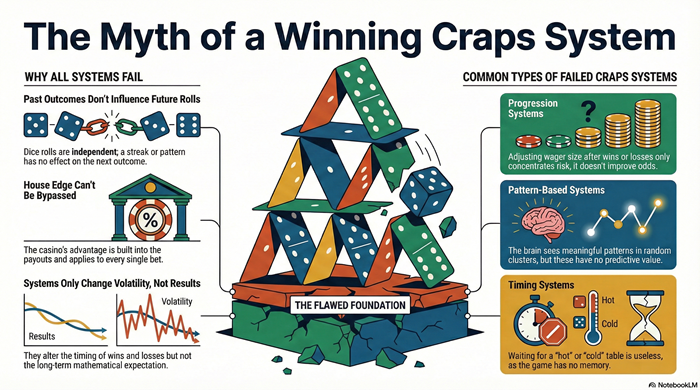
No amount of waiting, reacting, sequencing, or adjusting can change that relationship.
Behavior can change exposure timing. It cannot change the math.
Why Understanding House Edge Matters
House edge explains why the casino wins over time without requiring:
- manipulation
- adaptation
- player mistakes
The advantage exists because of structure, not exploitation.
What Comes Next
House edge explains long-term expectation.
It does not explain why actual results feel chaotic, emotional, or contradictory.
That experience is shaped by variance and independence—covered in the next articles.
Related Pages
- How Craps Really Works: Dice Probability, Bets, and Why Myths Persist
- Craps Dice Probability Explained: Why 7 Appears More Often Than Other Numbers
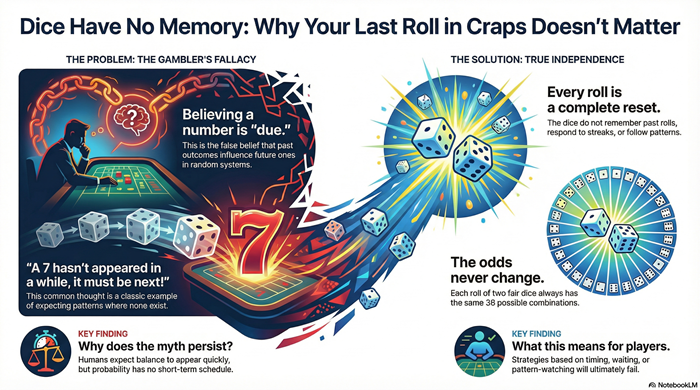
- Are Dice Rolls Independent in Craps? Why Previous Rolls Don’t Matter
- Variance in Craps: Why Results Swing Wildly Even When Odds Are Fixed
- Common Craps Systems Explained—and Why They Fail Mathematically