
Are Dice Rolls Independent in Craps? Why Previous Rolls Don’t Matter
This article is part of our complete guide on How Craps Really Works: Dice Probability, Bets, and Why Myths Persist , which explains craps probability, house edge, variance, and why common myths fail.
What “Independence” Means in Craps
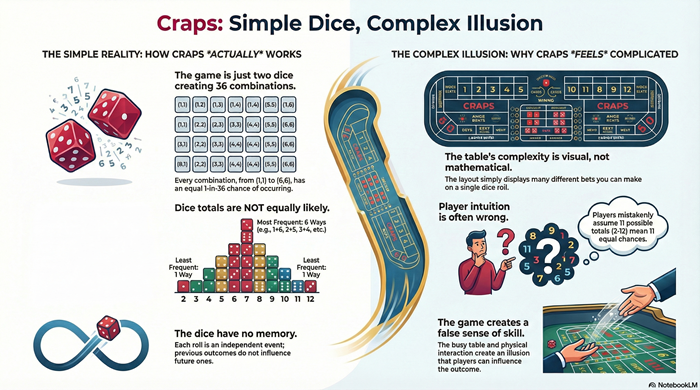
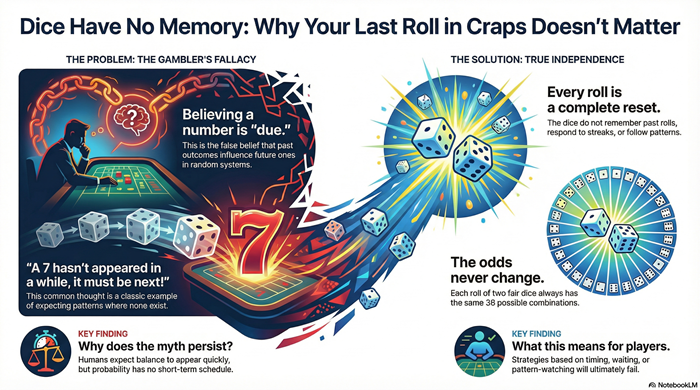
In craps, independence means that every roll of the dice is a complete reset.
Once the dice stop, the outcome is finished. Nothing about that outcome changes the probabilities of what happens next.
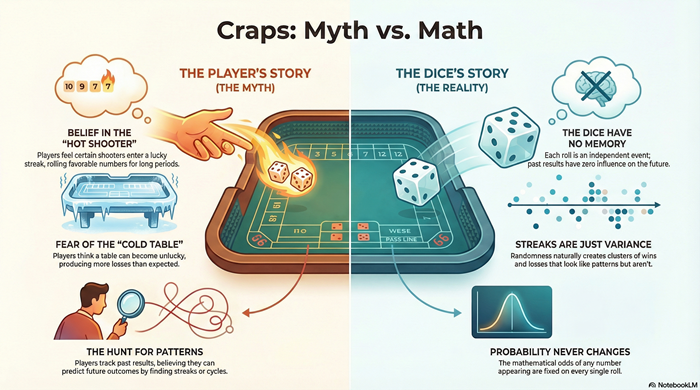
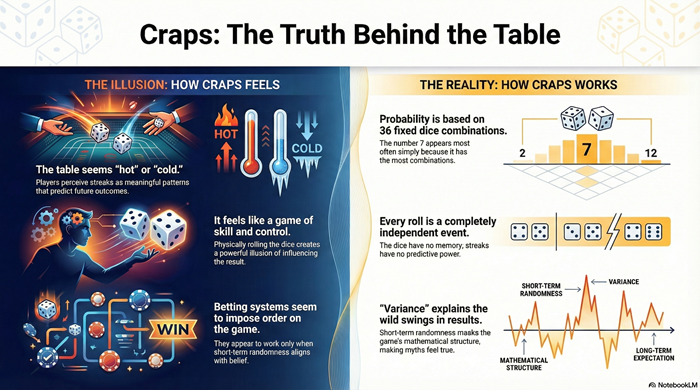
The dice do not remember previous rolls. They do not respond to streaks, gaps, or patterns.
Why Dice Rolls Cannot Influence Each Other
Each roll of two fair dice recreates the same physical conditions:
- two dice
- six faces per die
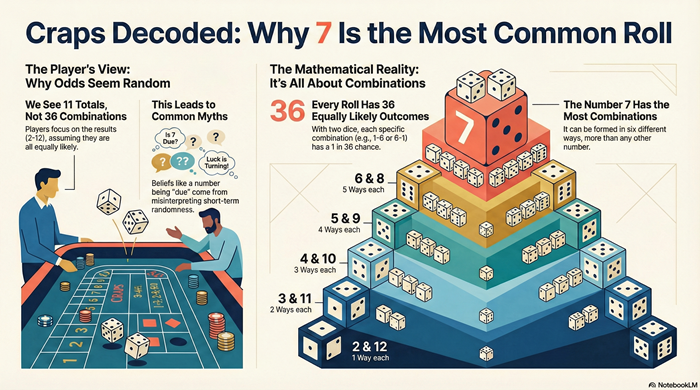
- 36 equally likely combinations
The probabilities are identical on every roll.
If outcomes depended on what happened before, probability itself would be unstable. It is not.
Independence Does Not Mean “Balanced”
A common misunderstanding is that independence implies outcomes should alternate or even out quickly.
This is false.
Independence allows repetition. It does not prevent it.
Rolling the same number multiple times in a row does not indicate bias or adjustment. It indicates randomness behaving normally.
Why Streaks Do Not Break Independence
Streaks feel meaningful because they are emotionally salient.
Mathematically, they are inevitable.
Random processes naturally produce:
- clusters
- runs
- long gaps
- unexpected reversals
None of these outcomes imply that future rolls are changing.
The Gambler’s Fallacy in Craps
What the Fallacy Claims
The gambler’s fallacy is the belief that past outcomes influence future ones in random systems.
Examples include:
- believing a 7 is “due” after a long absence
- believing a number is “used up” after appearing repeatedly
Why the Fallacy Persists
Humans expect balance to appear quickly.
Probability does balance over very large samples, but there is:
- no schedule
- no short-term obligation
- no corrective force per roll
The dice are under no pressure to compensate for recent history.
Independence vs Player Experience
Craps makes independence hard to accept because outcomes are:
- unevenly distributed
- visible and social
- emotionally reinforced
When similar results appear close together, the brain assumes connection.
The assumption is understandable—and wrong.
What Independence Explains
Understanding independence explains why:
- patterns do not predict future rolls
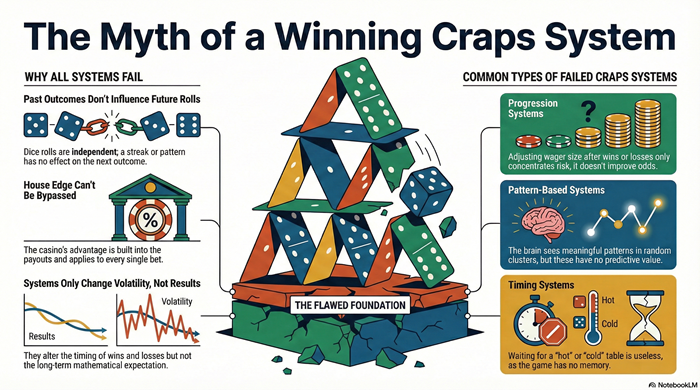
- timing strategies fail
- waiting does not improve outcomes
Independence removes the idea that the game can respond to observation.
What Independence Does Not Explain
Independence does not explain:
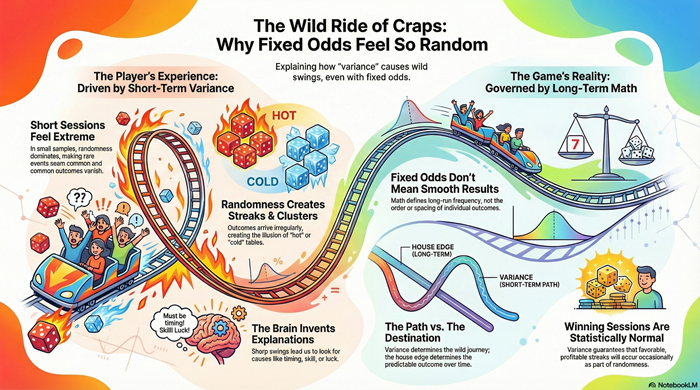
- extreme short-term swings
- emotional volatility
- contradictory sessions
Those effects are caused by variance, not dependence.
Why This Matters for Understanding Craps
If rolls are independent:
- past results cannot inform future ones
- no condition can become “good” or “bad”
- no sequence can be exploited
This principle dismantles many common beliefs about hot shooters, cold tables, and pattern watching.
What Comes Next
Independence explains why the game does not react to history.
To understand why results still feel chaotic and emotionally extreme, the next step is variance.
Related Pages
- How Craps Really Works: Dice Probability, Bets, and Why Myths Persist
- Craps Dice Probability Explained: Why 7 Appears More Often Than Other Numbers
- Variance in Craps: Why Results Swing Wildly Even When Odds Are Fixed
- Why Craps Looks Like a Skill Game (But Isn’t): Complexity, Rituals, and Control Illusions
- Myths About Craps That Refuse to Die