
The Mechanical Nature of Baccarat
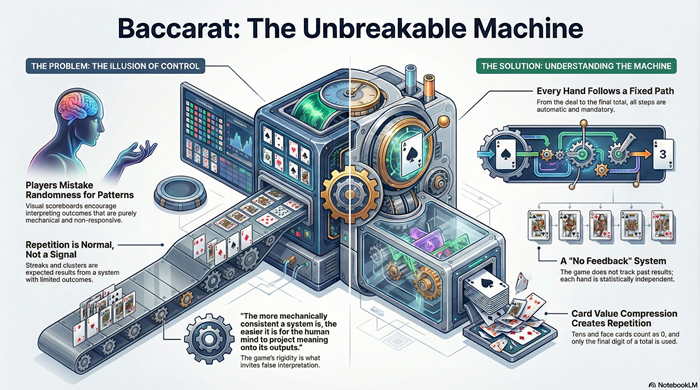
Baccarat is best understood as a mechanically resolved game. Once a hand begins, everything that follows is determined by fixed rules rather than player decisions. This mechanical structure explains why baccarat behaves the way it does—and why so many interpretations of the game miss the mark.
Understanding baccarat requires stepping away from narratives about timing, intuition, or control and focusing instead on how the game actually processes cards into outcomes.
Fixed Resolution, Not Player Choice
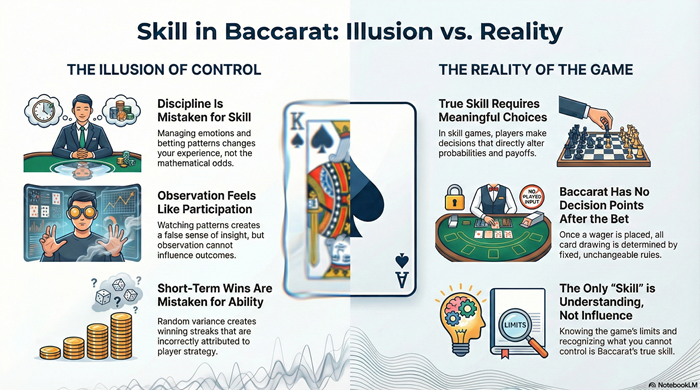
In baccarat, there are no discretionary actions once the cards are dealt. Unlike many other card games, players do not decide whether to draw, stand, or change course mid-hand. Every step of the hand’s resolution follows predefined procedures.
A baccarat hand resolves through a consistent sequence:
- Cards are dealt to the Player and Banker hands.
- Totals are calculated using a fixed scoring system.
- Mandatory drawing rules determine whether third cards are drawn.
- The final totals are compared to determine the outcome.
At no point does player behavior influence this process. The same rules apply to every hand, regardless of what came before.
Card Value Compression
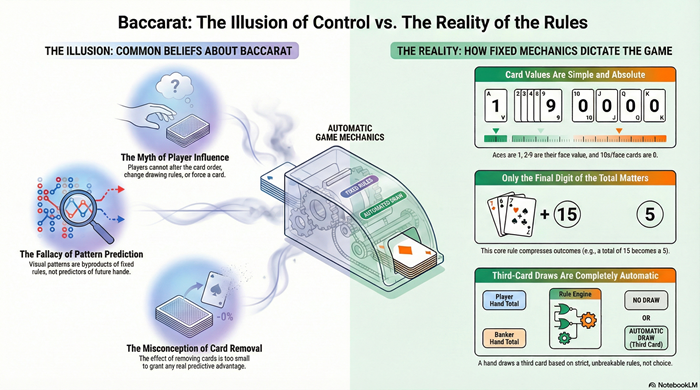
One of the most important mechanical features of baccarat is card value compression. Cards are not counted at face value in a way that preserves full numerical information. Instead:
- Aces count as 1.
- Cards 2 through 9 count as face value.
- Tens and face cards count as 0.
- Only the final digit of a total is used.
This compression means that many different card combinations resolve to the same total. For example, totals of 10, 20, or 30 all become 0. As a result, baccarat produces repeated outcomes far more often than games with broader scoring ranges.
Repetition is not unusual behavior—it is the expected outcome of a compressed scoring system.
Mandatory Drawing Rules
Baccarat’s third-card rules are fixed and automatic. They do not adapt to context, outcomes, or expectations. Whether a third card is drawn depends solely on the current total and, in some cases, the opposing hand’s draw.
These rules serve one purpose: to complete the hand mechanically. They do not introduce flexibility or strategy. Every possible hand follows the same logic every time it appears.
This rigidity eliminates uncertainty about how hands are resolved. While outcomes remain probabilistic, the resolution path itself never changes.
Outcome Compression and Repetition
Because baccarat compresses both card values and resolution paths, the game naturally produces:
- Clusters of the same outcome
- Apparent streaks
- Repeated totals
These behaviors are not signs of imbalance or pattern formation. They are normal outputs of a system that maps many inputs onto a small set of results.
When repetition occurs, it does not indicate momentum or correction. It indicates that the same mechanical process has been applied again.
No Feedback Loop
A mechanical system requires a feedback mechanism to adjust behavior. Baccarat has none.
The game does not:
- Track past outcomes
- Respond to streak length
- Adjust probabilities to “balance” results
- Incorporate history into future hands
Each hand is resolved in isolation using the same rules and the same probability structure.
Without feedback, there is no basis for claims that the game is changing, adapting, or signaling anything about what comes next.
Why Mechanical Games Invite Interpretation
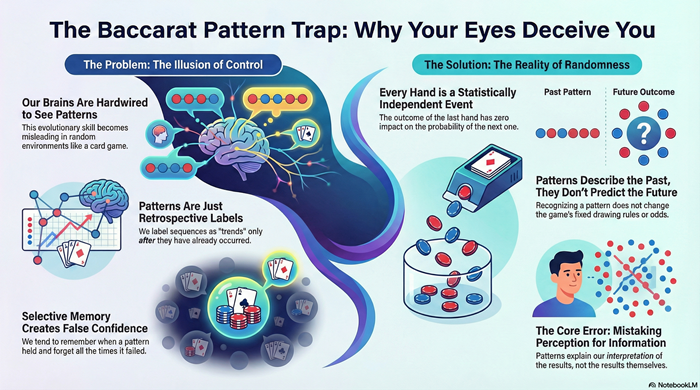
Despite its rigidity, baccarat generates rich visual information. Scoreboards, bead roads, and pattern charts present history in structured formats. This presentation encourages interpretation even though the underlying system is non-responsive.
The more mechanically consistent a system is, the easier it is for the human mind to project meaning onto its outputs.
Baccarat’s mechanics produce outcomes that look interpretable—but cannot be influenced.
Understanding the Machine
When baccarat is treated as a machine rather than a conversation, its behavior becomes easier to understand. The game does not reward observation, memory, or timing. It produces outcomes according to fixed rules and stable probabilities.
The mechanical nature of baccarat is not a flaw or a trick. It is the defining characteristic of the game.
Once this is understood, many misconceptions fall away. Baccarat is not mysterious. It is consistent.