
Why “Trend” and “Chop” Are Descriptive, Not Predictive in Baccarat
This article is part of our complete guide on How Baccarat Really Works: Odds, House Edge, and Why Systems Fail, which explains baccarat odds, house edge, card structure, and why betting systems fail.
This article explains what the terms “trend” and “chop” mean in baccarat language, why they describe past outcome sequences only, and why labeling a sequence does not change future probability. It does not discuss how to follow trends, how to react to chops, or how to wager. Its purpose is to clarify terminology and separate description from prediction.
What “Trend” and “Chop” Mean in Baccarat
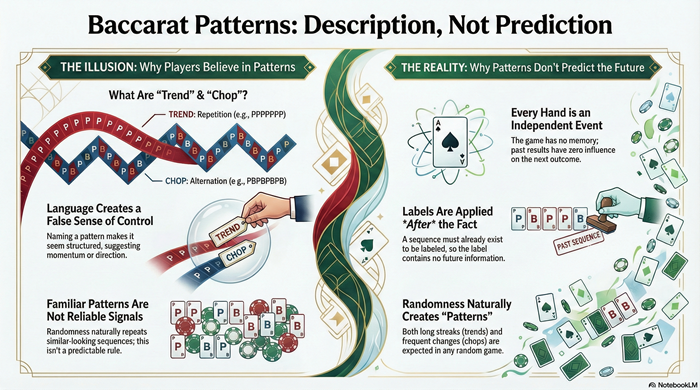
In baccarat, a trend typically refers to repeated occurrences of the same outcome over consecutive hands. A chop refers to frequent alternation between outcomes.
These terms are labels, not mechanics. They summarize what has already happened. They do not represent forces acting on the game.
Once a sequence is visible, it is categorized. The categorization does not exist before the outcomes occur.
Why These Labels Are Applied After the Fact
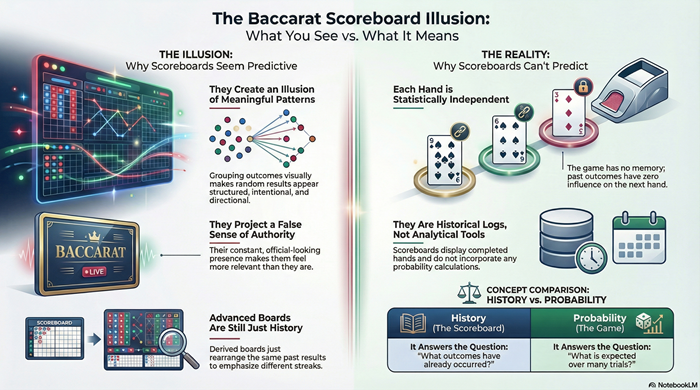
“Trend” and “chop” are retrospective descriptions. They rely entirely on historical data.
A sequence must already exist before it can be labeled. This means:
- The label depends on past outcomes
- The label appears only after confirmation
- The label contains no forward information
This retrospective nature is critical. Predictive information must exist before an outcome, not after it.
Random Sequences Naturally Produce Trends and Chops
Random processes generate both repetition and alternation without intent. Over time, sequences will include:
- Extended runs of the same result
- Rapid alternation between results
- Irregular mixtures of both
Neither behavior is exceptional. Both are expected features of randomness under stable probabilities.
Seeing either does not imply a change in the process that generated them.
Why Trends and Chops Do Not Influence Future Hands
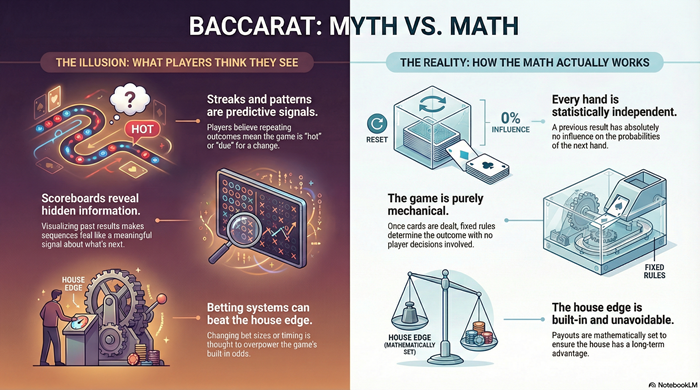
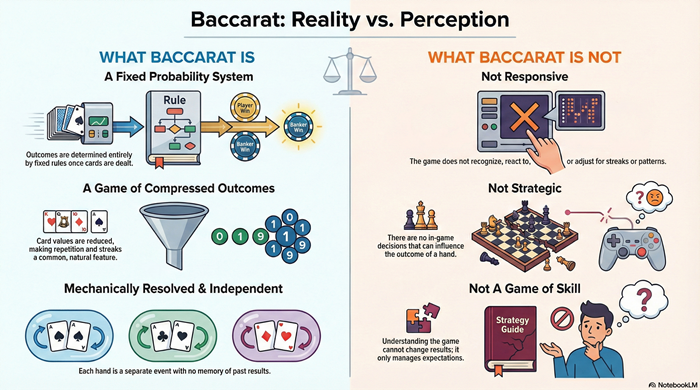
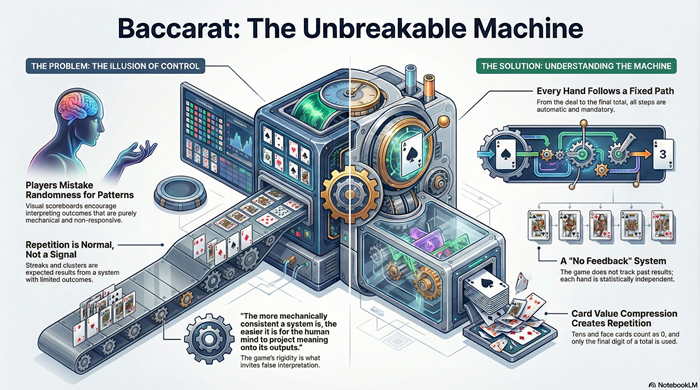
For a trend or chop to be predictive, it would need to alter the probability of upcoming outcomes. Baccarat does not provide any mechanism for this.
Each hand:
- Is resolved independently
- Uses fixed drawing rules
- Ignores prior sequences
Whether a table is labeled “trending” or “choppy” has no effect on how the next hand is dealt.
Language Creates the Illusion of Control
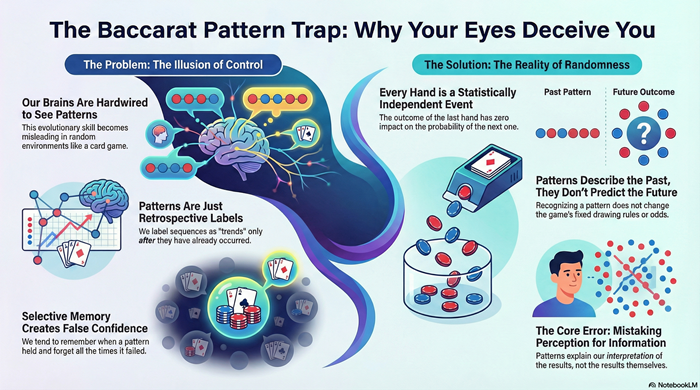
Naming a sequence creates the impression of structure. Language simplifies complexity, but it can also mislead.
Terms like “trend” and “chop” suggest:
- Direction
- Momentum
- Continuation or reversal
These implications come from language, not mathematics. The game does not recognize the labels applied to its outcomes.
Why Similar Sequences Keep Reappearing
Players often notice that trends and chops appear repeatedly across sessions. This familiarity is mistaken for reliability.
In random environments:
- Similar-looking sequences recur naturally
- Repetition of form does not imply repetition of outcome
- Recognition does not equal predictability
The sequence looks familiar because randomness reuses shapes, not because it follows rules.
Trend Language vs. Probability Language
Trend language describes what happened. Probability language describes how outcomes behave over time.
Confusing the two leads to false inference. Probability remains constant even as descriptive labels change.
A change in description does not indicate a change in distribution.
What “Trend” and “Chop” Explain — and What They Do Not
“Trend” and “chop” explain:
- How outcomes can be grouped visually
- Why scoreboards look structured
- How sequences are summarized
They do not explain:
- Future outcomes
- Shifts in probability
- Advantage or expectation
Their role is descriptive, not analytical.
Conclusion: Labels Do Not Carry Information Forward
In baccarat, “trend” and “chop” are names given to past sequences. They do not interact with the game’s mechanics or alter probability.
Understanding their descriptive nature removes an entire layer of misconception. The labels change how history is talked about, not how the next hand will be resolved.