
Baccarat Card Structure and Drawing Rules Explained
This article is part of our complete guide on How Baccarat Really Works: Odds, House Edge, and Why Systems Fail, which explains baccarat odds, house edge, card structure, and why betting systems fail.
This article explains how baccarat cards are structured, how drawing rules work, and why outcomes are mechanically determined rather than influenced by players or patterns. It does not discuss betting, wagering choices, or systems. Its purpose is to clarify the physical and rule-based mechanics that generate baccarat outcomes.
How Baccarat Uses Cards
Baccarat is played using standard 52-card decks, typically combined into a multi-deck shoe. The number of decks does not change the rules of the game, but it does affect card distribution over time.
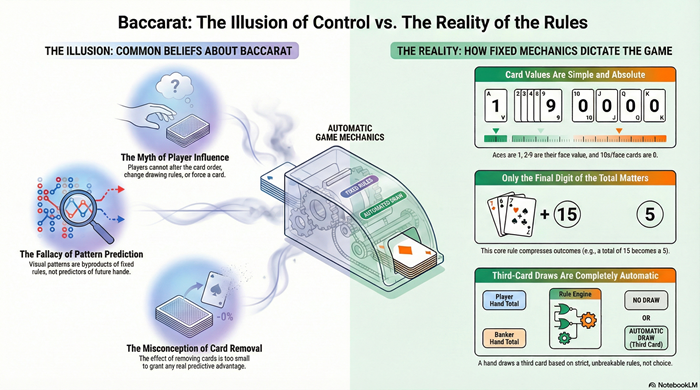
Card values in baccarat are fixed and simplified:
- Aces count as 1
- Cards 2 through 9 count as face value
- 10s, Jacks, Queens, and Kings count as 0
Only the final digit of a hand’s total matters. For example, a total of 15 is treated as 5. This rule compresses outcomes into a narrow numerical range and is central to how baccarat probabilities behave.
Why Baccarat Hand Totals Are Structurally Limited
Because only the final digit of a hand’s total is used, baccarat hand values are constrained to a small set of possible results. This limitation is not incidental—it is a core design feature.
Structural consequences of this system include:
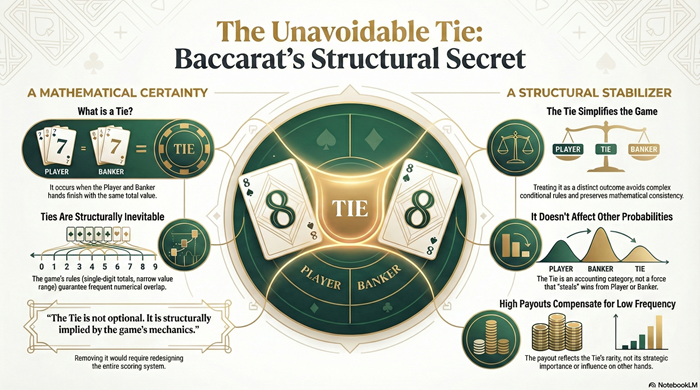
- Frequent ties in raw card totals
- Small numerical differences between outcomes
- High sensitivity to drawing rules
These constraints make baccarat outcomes appear repetitive or patterned, even though they are produced by rigid mechanics.
Initial Dealing: The First Two Cards
Each baccarat hand begins with two cards dealt to both the Player and Banker hands. These initial cards establish the base state of the hand before any additional drawing rules are applied.
At this stage:
- No decisions are made by players
- No discretion exists for altering the deal
- Outcomes are already partially constrained by card order
The apparent simplicity of the initial deal masks the complexity introduced by the next phase of the game.
The Third-Card Drawing Rules
Baccarat’s defining feature is its fixed third-card drawing system. Whether a hand receives an additional card is determined entirely by pre-set rules based on current totals.
These rules apply independently to the Player and Banker hands and are not symmetrical.
Key characteristics of the drawing system:
- The Player hand follows a simple threshold-based rule
- The Banker hand follows a conditional rule dependent on both hands
- No player input is allowed at any point
This system creates predictable probability distributions while remaining opaque to casual observation.
Why the Drawing Rules Matter More Than the Cards Themselves
Many baccarat misconceptions focus on individual cards or card sequences. In reality, the drawing rules exert far more influence than any single card.
Because the Banker’s draw conditions reference the Player’s third card, outcomes are coupled in a way that feels reactive but is entirely deterministic.
This interaction:
- Shapes outcome frequency
- Influences long-run distribution
- Contributes directly to house edge differences
Importantly, this behavior is not adaptive. The rules do not respond to history or trends.
Why Players Cannot Influence Card Flow
Once cards enter the shoe, their order is fixed until reshuffled. Players cannot:
- Alter draw conditions
- Skip unfavorable cards
- Force or prevent third cards
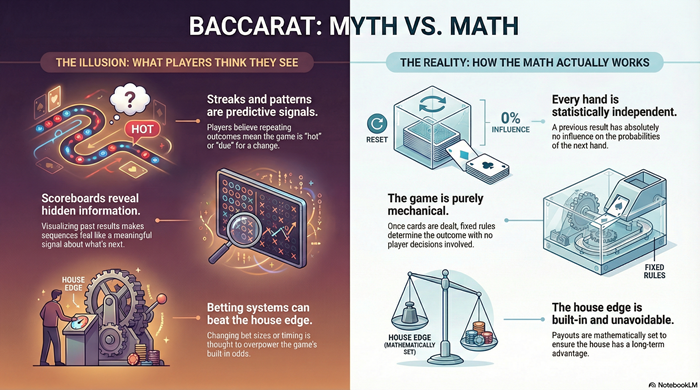
All outcomes emerge from the interaction of shuffled cards and rigid rules. Perceived control is an illusion created by the game’s presentation, not its mechanics.
Card Removal and the Illusion of Predictability
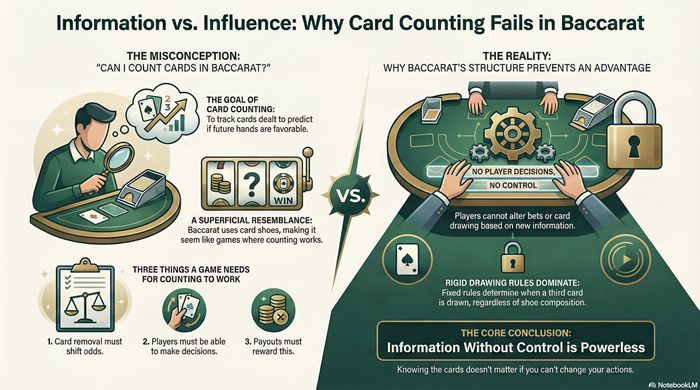
As cards are dealt, the remaining composition of the shoe changes. While this is mathematically true, it does not grant actionable control.
Reasons card removal does not create usable predictability:
- Drawing rules dominate outcome behavior
- Value compression reduces informational leverage
- Small composition shifts are overwhelmed by rule effects
What appears to be evolving structure is, in practice, statistical noise.
What Baccarat’s Card Structure Explains — and What It Does Not
Baccarat’s card structure explains:
- Why outcomes cluster visually
- Why totals repeat frequently
- Why certain results feel dominant within short spans
It does not explain:
- Future hand outcomes
- Session-level trends
- When outcomes will change
Mistaking mechanical repetition for predictability is one of the most common analytical errors in baccarat.
Conclusion: Mechanics, Not Momentum
Baccarat outcomes are produced by fixed card values, rigid drawing rules, and constrained totals. These elements interact mechanically, not dynamically.
Once the cards are shuffled, every hand follows the same process. No interpretation, timing, or observation alters that path. Understanding the structure clarifies why patterns appear—and why they do not confer influence.