
Prediction vs Profitability in Sports Betting
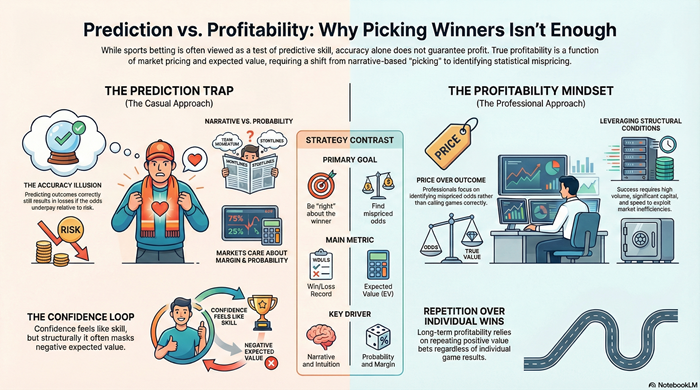
Sports betting often feels like a contest of prediction. If you can accurately forecast what will happen in games, profit seems like it should follow naturally.
In practice, prediction and profitability are very different things.
Many bettors predict outcomes reasonably well and still lose money. A much smaller group focuses almost entirely on pricing and expectation rather than prediction and achieves very different results. The gap between these two approaches explains much of the confusion surrounding sports betting.
This article is part of a broader educational guide explaining how sports betting works at a structural level, including odds pricing, implied probability, expected value, variance, and why certain bets are inherently risky. For the full overview, see How Sports Betting Really Works: Odds, Expected Value, and Why Parlays Are So Dangerous.
Why Accurate Predictions Don’t Guarantee Profit
Predicting outcomes feels central because it is visible and familiar. Games end with winners and losers. Predictions are either right or wrong.
Profitability, however, depends on price.
If the odds underpay relative to the true likelihood of an outcome, correct predictions still produce negative results over time. The bettor may feel skilled, informed, and justified while quietly paying the house edge.
This is why bettors often say they “pick winners but don’t make money.” Accuracy alone does not determine expected value.
How Professionals Think Differently
Professional betting, where it exists, is not focused on calling games correctly. It is focused on identifying mispriced odds.
The key distinctions are structural:
- Price matters more than outcome
- Small advantages matter more than confidence
- Repetition matters more than individual wins
Professionals are not trying to be right as often as possible. They are trying to be paid more than the risk justifies.
This difference in objective leads to radically different behavior.
Why Fans Struggle With This Distinction
Sports fandom trains people to think narratively. Teams have momentum. Players are hot or cold. Matchups feel decisive.
Betting prices do not care about narrative. They care about probability and margin.
When bettors carry narrative thinking into a pricing system, prediction becomes the focus and price becomes secondary. This reversal makes losses feel confusing and unfair.
Why Confidence Feels Like Skill
Confidence is persuasive because it feels earned. Research, experience, and intuition all contribute to belief.
Sports betting rewards confidence emotionally while punishing it structurally.
- Confident bets feel justified
- Winning reinforces belief
- Losing is framed as bad luck
This emotional loop sustains engagement even when expected value remains negative.
Why Profitability Requires Conditions Most Bettors Don’t Have
True betting profitability depends on conditions that casual bettors rarely possess:
- Access to favorable pricing
- Ability to place sufficient volume
- Capital to withstand variance
- Speed and scale to exploit inefficiencies
Without these conditions, even accurate prediction struggles to overcome the built-in margin.
This is not a personal shortcoming. It is a structural limitation.
Why This Distinction Resolves Confusion
Once prediction and profitability are separated, many contradictions disappear.
- Being right stops feeling like proof
- Being wrong stops feeling like failure
- Confidence loses authority
- Pricing becomes central
Sports betting stops being a referendum on intelligence and becomes what it actually is: a market with built-in disadvantage for participants who accept posted prices.
Why Understanding Matters More Than Outcomes
Understanding the difference between prediction and profitability does not create an edge. It removes illusion.
It explains why effort does not scale with results, why confidence rises before losses, and why short-term success feels meaningful even when it is not.
Clarity replaces expectation. Interpretation replaces frustration.
That shift is the real value of understanding how sports betting works.