
The Illusion of Luck: Decoding the Hidden Architecture of Online Gambling
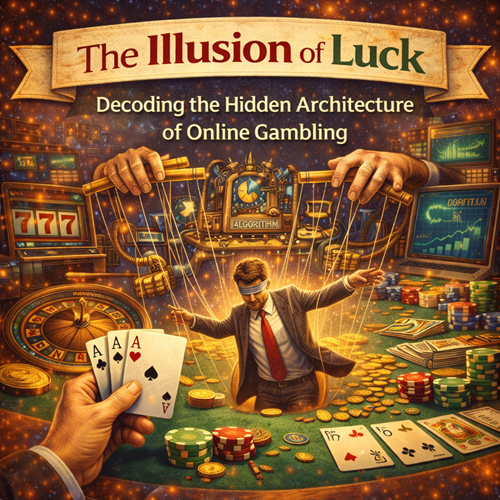
Online gambling platforms represent a masterclass in digital engineering, where outcomes are governed by unyielding mathematics rather than the whims of fortune. The environment is meticulously structured using a synthesis of psychological triggers and financial traps to ensure an inevitable outcome for the operator. This architecture guarantees that every session, regardless of perceived “luck,” contributes to a predictable and relentless flow of capital from the player to the house ledger.
The Illusion of Randomness and Digital Mapping
- Digital randomness is a theatrical element used to simulate fairness while masking a perfectly engineered disadvantage.
- Online casinos rely on Pseudo-Random Number Generators (PRNGs), which are deterministic algorithms that generate sequences from a “seed” input, such as the millisecond of the server’s system clock.
- The technical architecture allows for a massive number output—often up to 4.2 billion possible numbers—which the software then maps to specific game outcomes.
- While the PRNG’s selection of a number is technically unbiased and third-party audited, the underlying “blueprint” utilizes weighted reel mapping and unequal outcome distribution.
- This mapping allows the computer to assign millions of numbers to losing combinations while only a few correspond to a jackpot, resulting in asymmetrical odds that favor the house.
- By understanding this design, it becomes clear that “random” does not mean “equal”; the system is a purely mathematical visualization of a negative expected value equation.
Beyond the House Edge: The Mechanics of the “Churn”
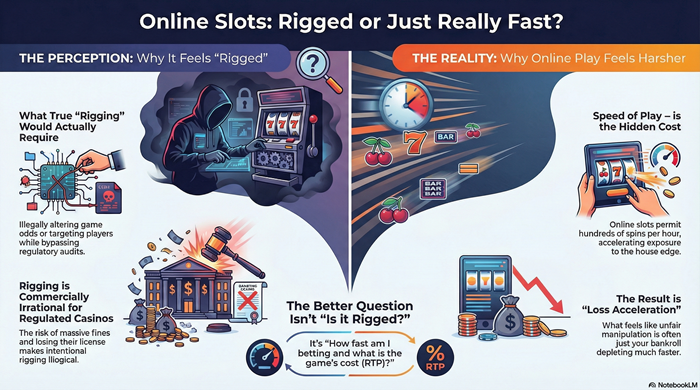
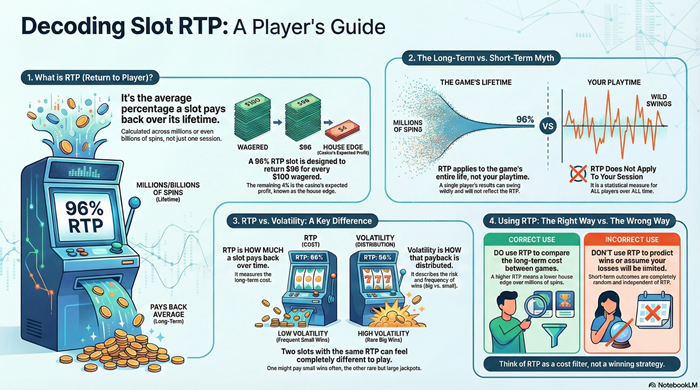
- Sophisticated extraction relies on the distinction between the theoretical Return to Player (RTP) and the actual “hold percentage,” where a minor 4% house edge is amplified through the process of “churn.”
- The house edge is not a one-time tax on a deposit; it is a relentless grind that applies to every wager made as a player reinvests small wins back into the system.
- By leveraging the Law of Large Numbers, operators process millions of daily spins to ensure that individual results converge upon theoretical results, turning short-term fluctuation into a fixed profit line.
- In sportsbooks, this mathematical certainty is achieved through the “vig” or “juice,” a built-in commission that locks in a profit margin regardless of the game’s athletic outcome.
- Casinos utilize variance and volatility as tools to create dramatic bankroll swings, using the noise of winning and losing to disguise the steady, downward financial trajectory of the player’s funds.
Psychological Hooks and Dopamine Loops
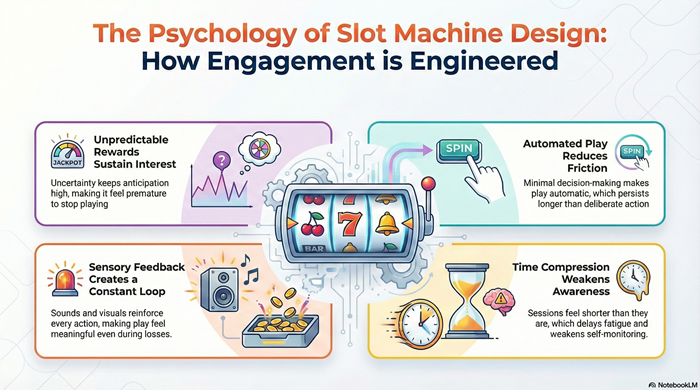
- Modern platforms utilize intermittent reinforcement—Skinnerian loops based on unpredictable reward schedules—to bypass logical centers and induce obsessive play.
- Neurological studies within cognitive psychology indicate that the dopamine spike peaks during the anticipation of the reward rather than the receipt of the payout itself.
- “Losses Disguised as Wins” (LDWs) use celebratory sensory feedback for payouts smaller than the original bet to mask overall financial decay with false positive reinforcement.
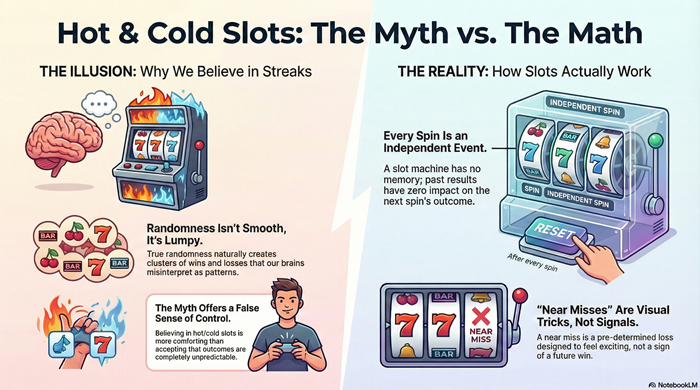
- The “Near-Miss Hook” involves visual displays specifically coded to simulate an “almost win” that is neurologically identical to a win but mathematically identical to a total loss.
- To foster an “Illusion of Control,” interfaces provide useless historical data—such as “hot” or “cold” numbers—to encourage the Gambler’s Fallacy and trick players into believing they can outmaneuver statistical certainty.
The Financial Tether: Why Bonuses Aren’t Generous
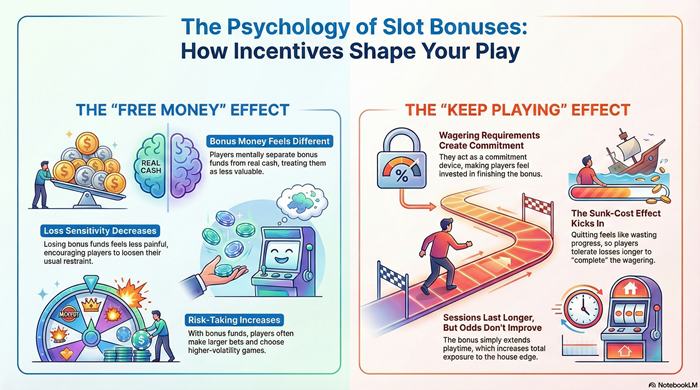
- A standard 30x playthrough requirement reveals the math behind the “gift”; for instance, a $100 bonus requires $6,000 in wagers, leading to an expected loss that statistically exhausts the entire balance.
- Bonuses function as a “mathematical tether” designed to lock a player’s real money into the ecosystem until the house edge can grind it down to zero.
- Operators prioritize Lifetime Value (LTV) models, aiming for a “slow, sustainable bleed” of a player’s budget rather than a sudden “bust out.”
- This strategy is used because a sudden total loss triggers emotional distress and self-exclusion, whereas the “slow bleed” maximizes long-term extraction from the player.
- It is critical to recognize that regulation does not change the blueprint; oversight merely codifies the house edge and ensures that the casino “robs you legally” and according to advertised specifications.
For More
To gain a deeper understanding of the specific mechanics governing individual games, readers are encouraged to consult the article on Slot Machine Guides. For a comprehensive surgical dissection of the entire industry’s architecture, the eBook “Rigged by Design: How Online Gambling Really Makes Money” is highly recommended and available for purchase on Google Books and directly through InfoArea. Observing the design clearly is the only way to neutralize the emotional compulsion of the gamble.