
Return to Player is Important to Slot Players
Mean on Slots?
The Number That Gets Talked About Most — and Understood Least
If you’ve spent any time reading about slot machines, you’ve seen RTP mentioned. Return to player. Usually expressed as a percentage — 96%, 94%, 97%. Most players have at least a vague sense that higher is better. Beyond that, things get blurry.
Some players treat it like a session guarantee — as if a 96% RTP means they’ll get £96 back from every £100 they put in. Others ignore it completely and just pick whatever game looks appealing. Neither approach is quite right.
RTP is genuinely useful information. But only if you understand what it’s actually measuring — and what it isn’t.
What RTP Actually Means
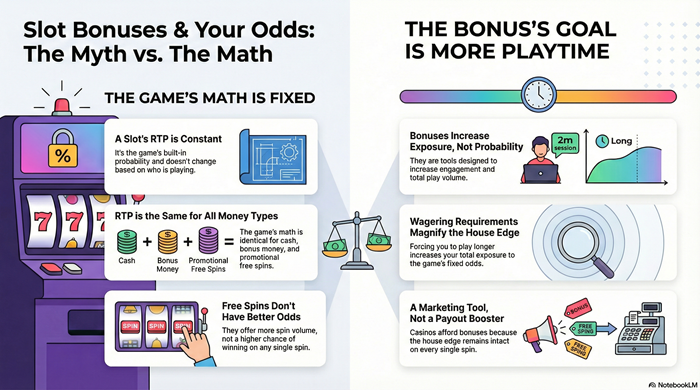
Return to player is a theoretical percentage that describes how much a slot game pays back to players over an enormous number of spins. A game with a 96% RTP is mathematically designed to return £96 for every £100 wagered — across millions of spins, averaged across all players.
That’s the key phrase: across millions of spins. RTP is a long-run statistical average, not a per-session prediction. It’s calculated by the game’s software developer by running through every possible combination of outcomes and weighting them by probability. The resulting number reflects the game’s overall payout structure, not what any individual player can expect on a Tuesday afternoon.
RTP is a long-run average across millions of spins. Your session might be 200 spins. In that time, your actual return could be anywhere from zero to several times your original stake — regardless of what the RTP figure says. The maths only truly smooths out at enormous scale.
How RTP Is Calculated
Developers build the RTP into the game’s maths before a single real player ever spins it. They define every possible symbol combination, assign a probability to each one, and set a payout for each winning outcome. When you add up all the expected returns across all possible outcomes, you get the RTP.
It’s then verified by independent testing laboratories — organisations like eCOGRA, iTech Labs, or GLI — who run the game through hundreds of millions of simulated spins to confirm the actual payout percentage matches what the developer declared. This is part of what makes licensed online casino games trustworthy: the numbers are checked by third parties, not just stated by the casino.
The RTP is fixed in the game’s code. A casino cannot change it for individual players or in response to recent results. The number you see in the pay table is the number the game runs at.
What RTP Doesn’t Tell You
This is where a lot of players trip up. RTP tells you the long-run theoretical return. It doesn’t tell you how that return is distributed — and distribution matters enormously for what a session actually feels like.
Two games can both have a 96% RTP and play completely differently. One might spread small wins frequently throughout a session. The other might go 300 spins with almost nothing happening, then deliver a large single payout that brings the average up. Same RTP. Completely different experience.
That distribution is what volatility measures. RTP and volatility together give you a much more complete picture than either number alone. RTP tells you the long-run cost of playing. Volatility tells you how those returns are likely to be structured during a session.
| RTP | What It Means | House Edge | Player Verdict |
|---|---|---|---|
| 98%+ | Very high return — rare in slots, more common in table games | Under 2% | Excellent value if you can find it |
| 96–97% | High for slots — considered a good benchmark | 3–4% | Solid — aim for this range when choosing games |
| 94–95% | Average — common across mainstream titles | 5–6% | Acceptable, but worth comparing to alternatives |
| 92–93% | Below average — typically land-based or progressive games | 7–8% | Higher long-run cost — only worth it if the game has other appeal |
| Below 92% | Low — significantly more expensive to play long-term | 8%+ | Avoid for regular play unless jackpot potential justifies it |
Where to Find RTP Before You Play
At reputable online casinos, RTP is usually available in the game’s info screen — the same panel that shows the pay table and bonus rules. Most software providers publish their game RTPs publicly, and many casinos list them on game description pages.
Some games offer variable RTPs depending on the platform hosting them. The same title might run at 96% on one casino and 94% on another. The in-game figure is the one that counts for wherever you’re actually playing. If it isn’t displayed in the game, the casino’s terms page or game information section should have it.
- Check the game info screen — RTP is usually listed alongside volatility and payline count.
- If it’s not shown in-game, look at the casino’s game info page or terms section.
- The same game can have different RTPs on different platforms — always check where you’re playing.
- Licensed casinos are required to make RTP data available. If a casino hides it, that’s a red flag.
How to Actually Use RTP When Choosing Games
RTP won’t tell you what will happen in your next session. But used as a filter when picking games, it genuinely matters over time. If you’re choosing between two otherwise similar games, the one with the higher RTP is the better long-run choice — even a 2% difference adds up meaningfully across regular play. Pair the RTP with the volatility rating and you’ve got a proper basis for choosing a game that suits both your bankroll and your preferred session style.
A sensible approach: treat anything below 94% as something to think twice about, treat 96% and above as a reasonable baseline, and always check volatility alongside it. A 97% RTP high-volatility game plays very differently from a 97% RTP low-volatility game — and for many players, the low-volatility version will feel like better value even though the numbers are identical on paper.
- 1. RTP is a long-run theoretical average across millions of spins — not a per-session guarantee.
- 2. A 96% RTP means the game returns £96 per £100 wagered over an enormous sample, not in your session.
- 3. RTP is set by the software developer and verified by independent testing labs — it cannot be adjusted per player.
- 4. The same game can have different RTPs on different casino platforms — always check in-game.
- 5. Use RTP alongside volatility — the two numbers together give you a complete picture of a game.
- 6. As a benchmark, 96% and above is considered solid for online slots.
Where to Play — Casinos That Publish Their RTPs
The best online casinos are transparent about game RTPs and host software from providers with independently verified numbers. All three below meet that standard and are well-regarded by US players.
Super Slots carries an extensive game library with titles from multiple reputable providers, weekly promotional offers, and fast crypto withdrawals. A strong all-round pick. Read the full Super Slots Casino Review for everything you need before depositing.
Slots LV is consistently well-regarded for its game selection and payout reliability. Our Slots LV Review covers bonuses, withdrawal times, and the full game range in detail.
And if you’d prefer to try a new casino without committing real money first, the exclusive offer at Slots Capital gets you 50 Free Spins with no deposit required — the lowest-risk way to explore a new platform. See the Slots Capital Review for the complete picture, and check the Slots Capital promotions page for what’s currently on offer.
Now you understand RTP — use it as one part of your game selection and play somewhere transparent and reliable.
Super Slots → Slots LV → exclusive offer — 50 Free Spins →Slots Capital — See All Promotions