
Why Slot Machines Never Feel Finished (No Natural Endpoints)
🎰🔄 Many activities end clearly. A hand of cards finishes. A sports game ends. Even most video games provide levels, checkpoints, or conclusions. Slot machines do none of these things — and that absence is not accidental.
Slots are designed to feel continuous, not complete. There is no natural moment where the game tells you it’s over, no signal that says “you’ve reached the end.” To understand why this matters, you have to look at how endings influence behavior. As explained in our guide on how slot machines really work, slot outcomes are governed by fixed probabilities — but session structure is shaped by design choices that deliberately avoid closure.
This article explains why slot machines lack natural endpoints, how that design affects player behavior, and why stopping feels unnatural even when play is no longer enjoyable.
What a “Natural Endpoint” Normally Does
In most activities, endpoints serve an important role.
They:
- Signal completion
- Allow evaluation of results
- Encourage rest or transition
When something ends, the brain naturally reassesses whether to continue.
Slots remove that moment entirely.
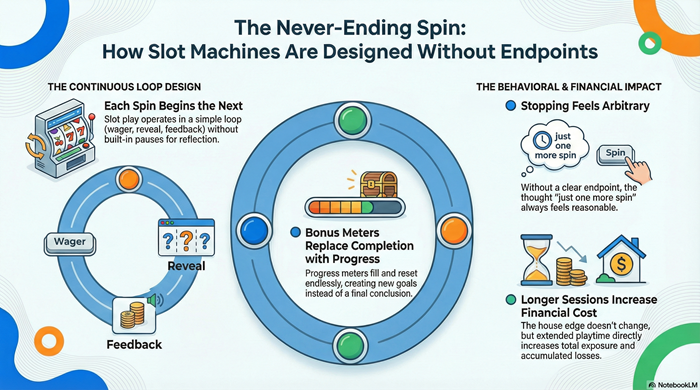
How Slots Replace Endings With Loops
Slot machines operate in loops.
Each loop includes:
- A wager
- A reveal
- Feedback
The end of one spin is immediately framed as the start of the next. There is no pause that invites reflection.
Without interruption, continuation becomes automatic.
Why “Just One More Spin” Feels Reasonable
Because slots lack endings, stopping feels arbitrary.
Players often think:
- “One more won’t matter”
- “I’ll stop after the next spin”
- “I’m already here”
Without a clear endpoint, there’s no obvious reason to stop now instead of later.
Later keeps moving.
How Endpoints Create Responsibility — And Why Slots Avoid Them
Endings force accountability.
When a session ends:
- Results can be judged
- Losses are tallied
- Decisions feel final
Slots avoid endings because finality triggers discomfort. By keeping play open-ended, losses remain unfinished and emotionally unresolved.
Unresolved experiences are easier to continue.
The Role of Continuous Feedback
Slots ensure that every action produces feedback.
Sound, motion, and animation:
- Confirm engagement
- Reward participation
- Replace closure
Feedback fills the space where an endpoint would normally exist.
As long as feedback continues, the session feels alive.
Why Bonus Meters Replace Endings
Bonus progress meters simulate goals without conclusions.
They:
- Fill gradually
- Reset endlessly
- Promise something later
When one bonus completes, another cycle begins. Completion never ends the session — it restarts it.
Progress replaces completion.
How Auto-Spin Eliminates Stopping Decisions Entirely
Auto-spin removes even micro-endpoints.
When spins trigger automatically:
- The player doesn’t decide to continue
- The loop runs uninterrupted
- Stopping requires deliberate intervention
Without decision points, endings disappear entirely.
Why Slot Sessions End From Exhaustion, Not Completion
Most slot sessions end because of:
- Balance depletion
- External interruption
- Physical or mental fatigue
They rarely end because the game itself signals it’s time to stop.
The ending arrives from outside the system.
Online Slots Intensify the Lack of Endpoints
Online slots amplify continuity.
They:
- Eliminate physical breaks
- Remove social cues
- Encourage solitary play
Without environmental interruptions, the loop persists longer than intended.
Why Players Feel Unfinished When They Stop
Stopping often feels uncomfortable because:
- The session lacked closure
- Progress felt ongoing
- Nothing resolved
This discomfort encourages return play — not because of loss recovery, but because of unresolved engagement.
How Lack of Endpoints Increases Cost
When there’s no end:
- Sessions extend
- Exposure increases
- Losses accumulate
The house edge doesn’t change — the duration does.
Longer loops mean higher cost.
Why This Design Is So Effective
Open-ended systems are powerful because:
- They reduce stopping cues
- They normalize continuation
- They remove pressure to decide
Slots don’t need to persuade players to keep going. They just avoid giving them a reason to stop.
What Understanding Endpoints Actually Changes
Understanding the absence of endpoints does not:
- Improve odds
- Reveal winning strategies
What it does change is expectation.
Players who recognize endpoint avoidance:
- Create artificial stopping points
- Set time or loss caps
- End sessions intentionally
Structure replaces ambiguity.
Continue Learning About Slot Machines
If you want to understand how slot machines extend play through design rather than math, these guides explain the mechanisms behind continuous engagement:
- How Slot Machines Really Work
- Why Slot Sessions Feel Shorter Than They Are
- Does Auto-Spin Increase Losses?
- Why Small Wins Feel Like Progress
- How Near Misses Manipulate Player Perception
- When to Walk Away From Slot Play
- Why Slot Machines Are Designed to Encourage Habitual Play
Each article explains one way slot design discourages stopping without changing odds.
Final Thought: No Ending Means No Signal to Stop
Slot machines don’t tell you when you’re done — because telling you would end the session.
Without endpoints, stopping feels like interruption instead of completion. Recognizing that design choice restores control.
When a game never ends, the only ending is the one you choose.