
Blackjack Strategies That Don’t Work (And Why Most Players Learn This Too Late)
Walk into any casino—or scroll through a few forums—and you’ll see the same patterns over and over. Players trying systems. Chasing losses. Trusting their instincts.
It feels like there must be a way to beat blackjack without getting too technical.
There isn’t.
Here’s what actually happens.
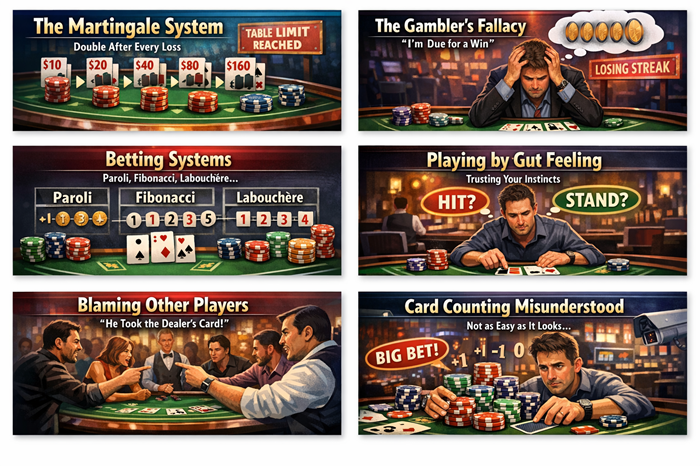
The Martingale System (Double After Every Loss)
This is probably the most popular “strategy” you’ll hear about.
The idea is simple:
Lose a hand → double your bet → keep doubling until you win → recover everything.
On paper, it sounds airtight.
Here’s what actually happens:
- Losing streaks last longer than you expect
- Bets escalate very quickly
- Table limits stop you from continuing
- Your bankroll runs out before you recover
This isn’t a strategy. It’s a risk accelerator.
The Gambler’s Fallacy (“I’m Due for a Win”)
This is where thinking quietly works against you.
After several losses, it’s natural to believe:
“I have to win soon.”
This is where most players get confused.
Each hand is independent. The cards don’t remember what just happened.
Even if you’ve lost 7 hands in a row, the next hand has the same odds as the first.
That feeling of being “due”?
It’s emotional—not mathematical.
Betting Systems (Paroli, Fibonacci, Labouchère)
Different names. Same idea.
- Increase bets after losses
- Or increase bets after wins
- Follow a sequence or pattern
What to expect:
- You might have short-term wins
- You will eventually hit a losing stretch
- The system collapses when that happens
Here’s what actually happens:
These systems only change how much you bet—not your chances of winning.
And that’s the part that matters.
Playing by Gut Feeling
“I just feel like hitting here.”
It sounds harmless. Sometimes it even works.
But over time:
- Emotional decisions drift away from optimal play
- Small mistakes compound
- The house edge quietly grows
Blackjack isn’t a guessing game. There are mathematically correct decisions for almost every situation.
Playing by instinct means ignoring them.
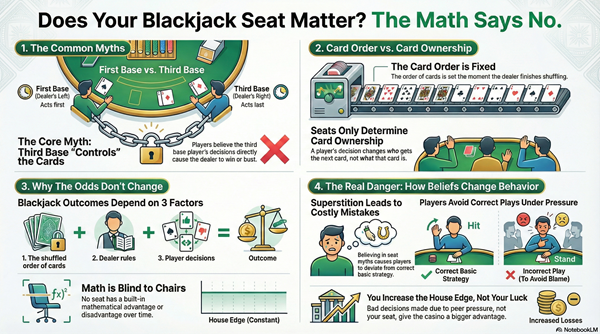
Blaming Other Players at the Table
You’ve probably heard this at a table:
“You took the dealer’s bust card.”
It feels real in the moment.
But over time, it evens out.
Other players:
- Sometimes help you
- Sometimes hurt you
- Mostly cancel out in the long run
This is more about frustration than strategy.
Chasing Losses with Bigger Bets
This is where things usually go sideways.
After a few losses, the thinking shifts:
“I’ll just bet more and win it back.”
Here’s what actually happens:
- You increase risk at the worst possible time
- Variance hits harder
- Losses get bigger, faster
This isn’t strategy—it’s reaction.
Card Counting (The Way Most People Try It)
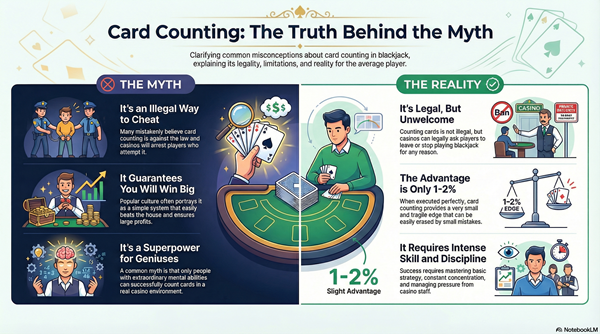
Card counting can work.
But not the way most people approach it.
What to expect:
- It takes serious practice
- It requires discipline under pressure
- You need a bankroll that can handle swings
And casinos:
- Use multiple decks
- Shuffle frequently
- Watch for patterns
Most players think they’re counting…
They’re not doing it well enough to matter.
The Real Takeaway
All of these strategies have one thing in common:
They try to beat blackjack without changing the odds.
That’s the core problem.
Here’s what actually helps instead:
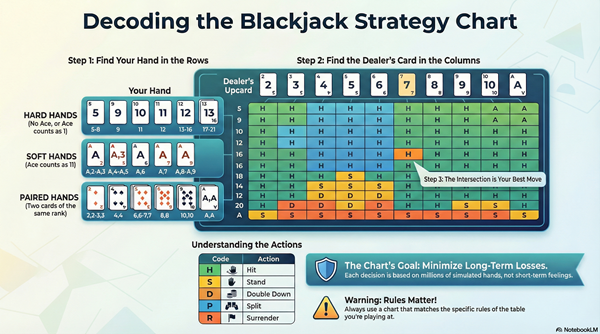
- Following basic strategy consistently
- Managing your bankroll before you sit down
- Understanding that the house edge is always there
Blackjack can be one of the better casino games in terms of odds—but only if you play it correctly.
Anything else?
It just makes the math work against you faster.
Practice First, Then Use Bonuses Strategically
Here’s the part most players skip—and it’s where everything actually starts to make sense.
Before you put real money down, spend time playing free blackjack (demo mode).
This is where you build the foundation:
- You learn basic strategy without pressure
- You get used to decision speed (hit, stand, double, split)
- You see how quickly mistakes add up
This is where most players get confused. They jump straight into real-money play, then try to “figure it out” while losing.
Instead, flip it:
Practice first → understand the flow → then play with a plan
What to Expect When You Switch to Real Play
Once you move from demo to real money, everything feels different:
- Decisions feel heavier
- Losing streaks feel more emotional
- Betting mistakes cost real money
That’s why practice matters. It removes hesitation and second-guessing.
Using Bonuses the Smart Way (Not the Emotional Way)
Once you’re comfortable, this is where casino bonuses can actually be useful—if you understand what you’re doing.
Instead of chasing wins, you’re doing something different:
- Extending your playtime
- Reducing how much of your own money is at risk
- Testing real sessions with a cushion
Here are solid options that consistently offer blackjack-friendly environments and bonuses:
🎰 Recommended Casinos to Explore
- Lucky Red Casino
👉 Lucky Red Casino
Review: Lucky Red Casino Review - Club World Casinos
👉 Club World Casinos
Review: Club World Casino Review - Aladdins Gold Casino
👉 Aladdins Gold Casino
Review: Aladdins Gold Casino Review - Buzzluck Casino
👉 Buzzluck Casino
Review: Buzzluck Casino Review - High Noon Casino
👉 High Noon Casino
Review: High Noon Casino Review - Manhattan Slots Casino
👉 Manhattan Slots Casino
Review: Manhattan Slots Casino Review - All Star Slots Casino
👉 All Star Slots Casino
Review: All Star Slots Casino Review - Crypto Reels Casino
👉 Crypto Reels Casino
Review: Crypto Reels Casino Review
The Right Way to Think About Bonuses
Here’s what actually happens when players use bonuses correctly:
- They don’t expect to “win big” immediately
- They use bonuses to learn real-money behavior
- They stay within limits and avoid chasing losses
And most importantly:
They understand that once a bonus is active, the rules (wagering, restrictions, caps) control everything.
Final Thought on This Section
If you take one thing from this:
Practice removes mistakes.
Bonuses extend your learning.
Neither guarantees profit—but both give you control.
That’s a completely different mindset than chasing systems that don’t work.