
What to Do After Splitting Aces or Eights in Blackjack
🂡 Splitting Aces or Eights is one of the first rules many blackjack players hear: “Always split Aces and Eights.” The advice is sound — but incomplete. The real mistakes don’t usually happen at the moment of the split. They happen after the split, when players misunderstand what the rules allow, what the math expects, and how these hands should be played going forward.
As explained in our Blackjack Basic Strategy guide, splitting Aces and Eights is not a superstition or a tradition. It’s a mathematically justified decision designed to reduce long-term losses or increase value. But the benefit only exists if players understand what comes next.
This article explains why Aces and Eights are split, what happens after the split under different rules, and how players often give back that advantage without realizing it.
🧠 Why Aces and Eights Are Treated Differently
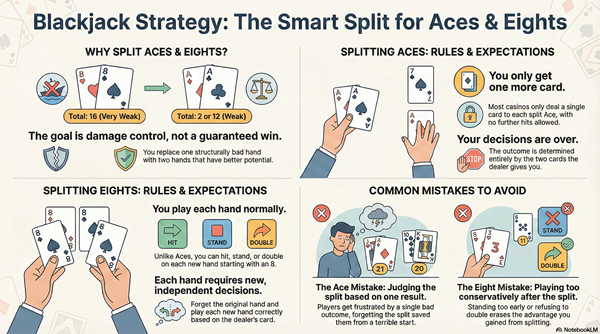
Not all pairs are equal in blackjack. Aces and Eights are unique because leaving them un-split produces some of the worst possible hands.
- Two Eights total 16 — one of the weakest hands in the game
- Two Aces total either 2 or 12 — neither of which is strong
Splitting doesn’t magically create winning hands. It removes structurally bad ones and replaces them with two hands that have better long-term potential.
This distinction is crucial: splitting Aces and Eights is about damage control and value recovery, not aggression.
🂱 What Happens After You Split Aces
When you split Aces, most casinos impose special restrictions. Typically:
- Each Ace receives only one additional card
- Further hits are not allowed
- Re-splitting Aces may or may not be permitted
These rules exist because Ace-based hands are powerful. Even with restrictions, splitting Aces improves expected value compared to playing them together.
After splitting Aces, your role as a player becomes simple:
You do not make decisions.
The outcome is determined by the single card drawn to each Ace.
Trying to “manage” these hands emotionally or second-guessing the result is pointless. The value of the split is already locked in.
⚠️ Common Mistakes After Splitting Aces
The most common mistake with split Aces isn’t tactical — it’s psychological.
Players often:
- Feel disappointed when a low card appears
- Feel cheated when a strong total loses
- Forget that the goal was avoiding a terrible starting hand
Because players don’t control the outcome after the split, they judge success based on short-term results instead of long-term value. This leads to frustration and poor decisions later in the session.
Splitting Aces works over time, not per hand.
🂡 What Happens After You Split Eights
Splitting Eights creates two starting hands of 8, which is far more playable than a hard 16.
Unlike split Aces:
- You usually can hit split Eights
- You may be allowed to double, depending on rules
- Each hand is played normally
This makes post-split decisions with Eights more complex — and more error-prone.
The goal after splitting Eights is not to protect the original decision. It’s to play each new hand correctly based on the dealer’s upcard and the cards you receive.
🧱 Why Playing Eights as 16 Is So Expensive
A hard 16 is one of the worst hands in blackjack because:
- Standing loses frequently
- Hitting busts often
- Neither option performs well
Splitting removes this dilemma entirely. Even if the resulting hands are not strong, they are less bad than the original 16.
Players who refuse to split Eights because they “don’t want to risk two hands” are unknowingly choosing the worst structural option.
🧠 Decision Discipline After Splitting Eights
Once Eights are split, each resulting hand must be treated independently.
Common errors include:
- Standing too early to “protect the split”
- Refusing to double on strong follow-up cards
- Playing conservatively because the bet is already doubled
These mistakes erase much of the value gained from the split. The correct approach is to forget the original hand entirely and apply normal decision logic to each new hand.
Splitting creates opportunity — but only if it’s followed by discipline.
🏛️ How Table Rules Affect Split Aces and Eights
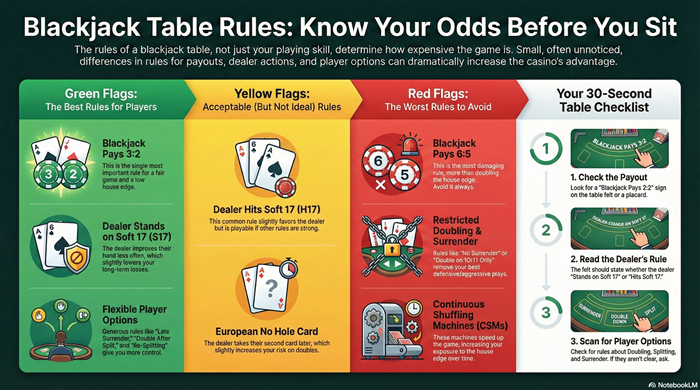
Not all tables treat splits equally. Important variations include:
- Whether re-splitting is allowed
- Whether doubling after split is permitted
- Whether split Aces receive only one card
These rules affect how much value splitting provides. Even under restrictive rules, splitting Aces and Eights almost always remains the correct decision — but expectations should be adjusted.
Understanding the rules prevents disappointment and misinterpretation of outcomes.
📉 Why Players Blame the Split (Instead of the Math)
When split hands lose, players often say:
“Splitting ruined the hand.”
In reality, the original hand was already in trouble.
Splitting doesn’t create losses. It reveals variance. It exposes two outcomes instead of hiding one bad expectation behind a single result.
Blaming the split is a psychological shortcut that prevents learning.
📊 Expected Value vs Short-Term Results
Splitting Aces and Eights improves expected value — not certainty.
That means:
- You will still lose split hands sometimes
- You may lose both hands occasionally
- You may feel unlucky even when playing correctly
Expected value works quietly. It shows itself over hundreds of hands, not in dramatic moments.
📌 Why This Rule Is So Widely Taught
“Always split Aces and Eights” persists because it solves a real problem:
- It removes two structurally weak hands
- It simplifies difficult decisions
- It consistently reduces long-term losses
The rule survives because it works — not because it feels good.
🔚 Final Thought: The Split Isn’t the Risk — Ignoring It Is
Splitting Aces and Eights doesn’t guarantee success. It guarantees that you are not voluntarily playing one of the worst hands in blackjack.
The danger isn’t splitting.
The danger is clinging to a bad structure because it feels familiar.
Blackjack rewards players who fix problems early — even when the solution feels uncomfortable.
🔗 Recommended Internal Links