
Unveiling the Math: Why Slot Machine Patterns Are a Psychological Illusion
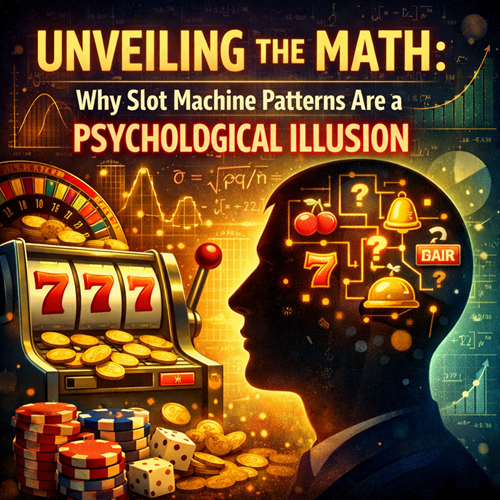
Slot machines are engineered mathematical systems where every outcome is governed by the rigorous laws of probability and statistical design. These gaming terminals utilize sophisticated software to ensure that each spin remains an independent event, disconnected from any prior history or external player interaction. By evaluating the structural mechanics of these machines, one can appreciate how randomness is systematically applied to maintain a fixed house edge over an infinite timeline.
The Reality of Independent Outcomes: Why Machines Never Run ‘Hot’ or ‘Cold’
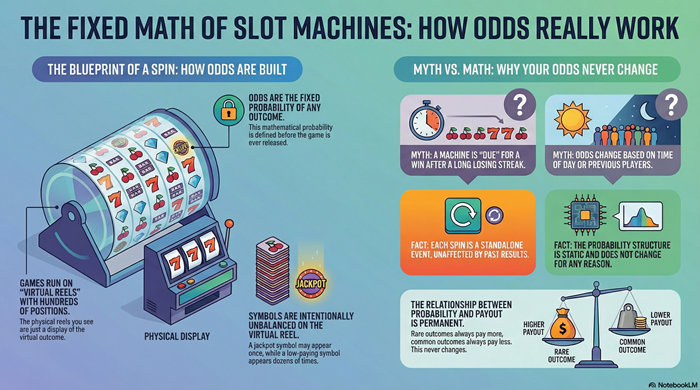
Modern slot machines operate without a memory of past events, effectively rendering terms like “hot” or “cold” mathematically irrelevant to future performance. From a structural standpoint, every spin is a discrete trial where the probability of any specific outcome remains constant regardless of whether the previous session resulted in a massive jackpot or a significant drought. What players interpret as winning or losing streaks are actually examples of high variance—a statistical concept where results fluctuate wildly in the short term while eventually gravitating toward the programmed average.
- The Random Number Generator (RNG) is a high-speed computational engine that cycles through thousands of distinct numeric combinations every second, ensuring that the millisecond a player initiates a spin, a fresh mathematical state is captured. This speed makes it physically impossible for a player to “time” a result, as the outcome changes significantly in the time it takes to blink.
- Although human cognitive evolution prioritizes pattern detection for survival, these perceived sequences in gameplay are psychological illusions rather than evidence of a predictive cycle within the machine’s source code. The brain naturally attempts to impose order on a random system, creating a narrative of “streaks” where only independent variables exist.
The ‘Near Miss’ Mirage: Why Symbols Are Only Visual Presentation
The determination of a winning or losing outcome occurs the exact moment the player engages the RNG, making the subsequent reel animation a purely cosmetic presentation of a finalized result. This visual sequence is achieved through weighted mapping, where the computer uses “virtual reels” to assign more RNG stop-points to non-winning symbols, causing them to appear more frequently on the visual display. Because the result is finalized instantly, a symbol landing just off the payline offers structural clarity regarding the machine’s internal state: it is not a signal of progress toward a jackpot, but a precise representation of a programmed reel position. Modern design utilizes these weighted positions to create tension, yet the mathematical architecture dictates that being “one symbol away” is functionally identical to a complete miss.
The Truth About Player Cards and Casino ‘Switches’
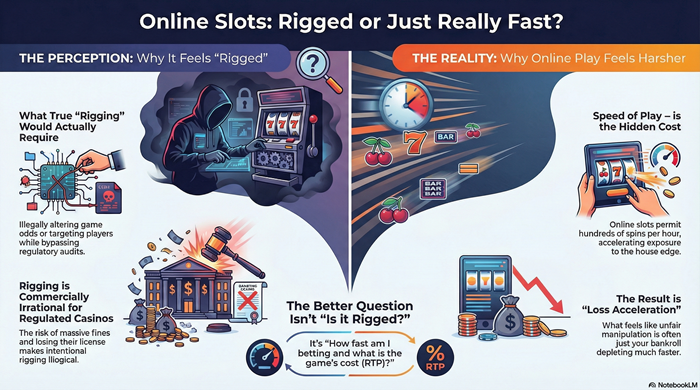
Player loyalty cards function exclusively as data-acquisition tools for marketing and rewards programs, maintaining no technical interface with the game’s core payout mechanics. Altering a machine’s Return to Player (RTP) percentage is a formal, documented procedure that requires strict regulatory compliance, including the use of encrypted software updates and rigorous physical security protocols. From the perspective of an industry analyst, the idea of “tightening” a machine during peak hours is a logistical and legal impossibility due to the auditing and software logging required by gaming commissions.
- The player card reader and the RNG are architecturally separate hardware and software systems, ensuring there is no feedback loop that allows player identity or wagering history to modify the probability of a spin. The machine calculates the odds of a win identically for an anonymous player as it does for a high-tier loyalty member.
- Confirmation bias frequently leads players to correlate high-traffic environments with losing sessions, incorrectly attributing a busy casino floor to a manual adjustment of the machine’s mathematical model. In reality, the higher volume of players simply makes the high number of losing sessions more visible to the casual observer.
The Falling Logic of ‘Due’ Jackpots and High Denominations
The Gambler’s Fallacy is a common cognitive error where players assume a machine is “due” for a payout, ignoring the reality that probability does not move toward short-term balance. This same logic applies to progressive systems; while a rising jackpot increases the potential payout, it does not create internal “pressure” or change the mathematical likelihood of the trigger occurring on the next spin. Furthermore, while higher denomination machines often exhibit different volatility—defined as paying out larger amounts less frequently—this variance does not alter the fundamental independent probability inherent in the mathematical architecture of each individual wager. The system is designed for long-term distribution, meaning that the odds of a specific hit remain static regardless of the denomination or how long the machine has been in play.
Added Information
An ebook called “Top 10 Myths About Slot Machines: Hot Machines, Near Misses, and the Truth Behind Every Spin” with more details on this subject is also available for FREE. You can find it at the following links: