
How Slot Machines Really Work: RTP, Volatility, and Odds Explained
🎰📊 Slot machines are the most popular casino games in the world — and also the most misunderstood. Many players believe slots are influenced by timing, streaks, machine behavior, or hidden patterns. Others think results can be improved by choosing the right game, playing at the right moment, or stopping at the right time.
Slot machines do not work that way.
Slot machines are mathematical systems that use random number generators (RNGs) to produce outcomes based on fixed probabilities. Each spin is independent, outcomes cannot be influenced by previous results, and the machine does not adjust based on player behavior, timing, or session length.
Every slot machine is built around three core elements:
- Random number generation, which determines outcomes instantly and independently
- Preset payout structures, which define how often and how much a machine can return over time
- Return to Player (RTP) and volatility, which describe long-term cost and payout behavior — not short-term results
Once these mechanics are understood, common slot myths fall apart — and the true cost of slot play becomes much clearer.
This guide is part of our complete Slot Machine Guides library, which explains RTP, volatility, randomness, casino control, and the psychology behind modern slot design.
This article explains how slot machines really work, how outcomes are determined, what RTP and volatility actually mean, and why most slot advice fails. It serves as the foundation for every other slot topic that follows.
In short, slot machines do not respond to player behavior — they execute predetermined probabilities every time a spin is placed.
How Slot Machines Actually Work
Slot machines work by generating a random number the moment a spin is placed. That number selects a predefined outcome from the machine’s probability table, and the reels simply display the result afterward.
Each spin is independent, uses fixed probabilities, and is not affected by timing, previous results, or player behavior.
What a Slot Machine Actually Is
A slot machine is a computer-controlled gambling device designed to produce random outcomes from a fixed set of probabilities. Although it appears to be a mechanical game with spinning reels and symbols, modern slots are digital systems that generate results instantly and then display those results visually.
Every slot machine contains software that defines:
- The possible outcomes
- How often each outcome can occur
- How much each outcome pays
These rules are set in advance and do not change based on player behavior, session length, or past results.
The reels, animations, sounds, and bonus features do not influence what happens. They exist to present the outcome selected by the machine’s internal logic. The appearance of motion, suspense, or near-success does not reflect a process unfolding — it reflects a result that has already been determined.
Understanding what a slot machine is helps clarify why it cannot react to timing, streaks, or “hot” and “cold” behavior. The machine is not watching, learning, or adjusting. It is executing predefined mathematical instructions and displaying the outcome.
Once this distinction is clear, many common beliefs about slots begin to collapse. What feels interactive or responsive is, in reality, a fixed system repeating probabilities exactly as designed.
How RNG Determines Slot Outcomes
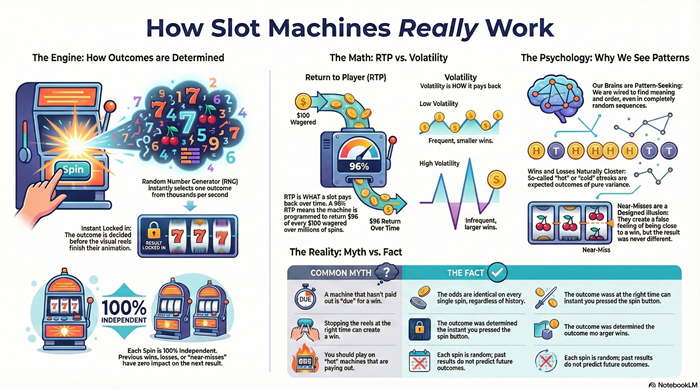
A random number generator (RNG) is the core system that determines every slot machine result. The RNG is a computer algorithm that continuously produces numbers at extremely high speed — thousands per second — whether anyone is playing or not.
When a player presses the spin button, the slot machine instantly captures the current number produced by the RNG. That number corresponds to a specific outcome stored in the machine’s probability table. The reels then spin purely to display that preselected result.
This means the outcome is decided:
- The moment the spin is placed
- Before any reels stop moving
- Without reference to previous spins
The RNG does not remember past results, track losses, or adjust based on session behavior. Each spin is mathematically independent.
For more detail on randomness in slots, see RNG Explained — Are Slots Truly Random?
Why Timing and Streaks Cannot Affect RNG Results
Because the RNG runs continuously and outcomes are selected instantly, timing has no influence on results. Pressing the button faster, slower, or at a “lucky” moment does not change the number captured.
Likewise, streaks have no meaning to the RNG:
- A slot that hasn’t paid recently is not more likely to pay next
- A slot that just paid is not less likely to pay again
- Long losing streaks do not create pressure for wins
These patterns feel meaningful because humans expect balance in the short term. RNGs do not behave that way.
How RNG Connects to Reels and Symbols
The spinning reels players see are a visual representation, not a decision mechanism.
Each RNG-selected outcome maps to:
- A specific reel combination
- A predefined symbol arrangement
- A fixed payout (or no payout)
The reels do not “land” on outcomes. They reveal them. This distinction explains why near misses, visual closeness, or reel positioning cannot indicate progress or probability.
Why RNG Is Central to Slot Fairness — and Cost
RNGs are tested and regulated to ensure outcomes are random and match the game’s certified probabilities. This ensures fairness of operation, but not fairness of results.
A fair RNG:
- Produces unpredictable outcomes
- Follows predefined probabilities exactly
- Still guarantees losses over time when the house edge exists
Randomness ensures honesty — not generosity.
What Understanding RNG Actually Changes
Understanding RNG does not:
- Improve odds
- Create winning strategies
What it does change is expectation.
Once players understand that every outcome is selected instantly and independently, ideas about timing, machine behavior, and streak correction lose their influence. Decisions become grounded in limits instead of patterns.
What RTP Means in Slot Machines
RTP (Return to Player) is the percentage of total wagered money a slot machine is programmed to return over time. It describes the long-term mathematical cost of a game, not what will happen in any single session.
For example:
- A slot with 96% RTP is expected to return $96 for every $100 wagered over millions of spins
- The remaining 4% represents the casino’s house edge
RTP is:
- Long-term
- Mathematical
- Unaffected by timing, session length, or player behavior
RTP does not mean:
- You will get 96% of your money back
- Losses are limited
- Wins are distributed evenly
A 96% RTP slot can lose heavily in a short session, go long stretches without paying, or cluster wins unevenly. RTP does not predict outcomes — it describes expected return across massive numbers of spins.
This misunderstanding is one of the biggest sources of slot myths. RTP tells you how expensive a game is, not how it will behave moment to moment.
How Slot Volatility Affects Wins and Losses
Volatility describes how a slot machine distributes its payouts, not how much it returns over time. While RTP explains a slot’s long-term cost, volatility explains what the experience feels like while you play.
Two slots can have the same RTP and behave very differently because of volatility.
Volatility determines:
- How often wins occur
- How large those wins tend to be
- How long losing streaks can last
It does not change:
- The house edge
- The long-term expected return
- The randomness of outcomes
Low, Medium, and High Volatility Explained
Slots are generally categorized into three volatility ranges.
Low-volatility slots pay smaller amounts more frequently. Sessions feel active and losses tend to appear gradual, even though the long-term cost remains the same.
Medium-volatility slots balance win frequency and payout size. They produce mixed sessions with occasional dry spells and occasional moderate wins.
High-volatility slots pay infrequently but can produce large wins. Sessions often include long losing streaks punctuated by rare, dramatic payouts.
None of these volatility levels improve odds. They only change how quickly and how noticeably losses appear.
Why Volatility Is Often Confused With RTP
Many players assume that frequent small wins mean a “better” slot.
In reality:
- Frequent wins can still produce steady losses
- Rare wins can create short-term excitement but large drawdowns
- Both can share identical RTP values
RTP tells you how expensive the game is.
Volatility tells you how that cost is delivered.
Confusing the two leads players to believe certain slots are safer, hotter, or more controllable than they actually are.
How Volatility Shapes Player Perception
Volatility strongly influences how players interpret sessions.
Low volatility:
- Feels stable
- Masks losses
- Encourages longer play
High volatility:
- Feels dramatic
- Fuels jackpot chasing
- Encourages persistence during losses
Neither changes the math. Both change behavior.
What Understanding Volatility Actually Changes
Understanding volatility does not:
- Improve RTP
- Predict wins
- Reduce house edge
What it changes is expectation.
When players understand volatility:
- Losing streaks feel less personal
- Wins feel less misleading
- Stopping decisions become clearer
Volatility explains experience — not opportunity.
Why Volatility Matters More Than RTP for Experience
Many players choose slots based only on RTP.
That’s incomplete.
Volatility determines:
- How long your bankroll lasts
- How often you feel rewarded
- How intense losses feel
- Whether sessions feel “cold” or “hot”
High volatility slots create the illusion of streaks more strongly, which reinforces false beliefs about machine behavior.
Key Takeaways
- Slot outcomes are determined by a Random Number Generator that makes each spin independent.
- RTP describes long-term return, not short-term results.
- Volatility determines payout rhythm, not value.
How Slot Odds Are Actually Determined
Slot odds are determined before play begins, not during a session. Every slot machine is programmed with a fixed probability structure that defines how often each possible outcome can occur. These probabilities do not change based on time, player behavior, or how the machine has performed recently.
Modern slots use virtual reels, not physical ones. Each virtual reel contains a large number of symbol positions, and those symbols are weighted unevenly. Common symbols appear more frequently, while high-paying symbols appear far less often. This weighting — not the visible reel layout — is what determines the true odds.
When a spin is placed, the random number generator selects one outcome from this predefined probability set. The reels then display the symbols that correspond to that outcome. The visual spacing of symbols on the screen does not reflect their actual likelihood of appearing.
In practical terms, this means:
- The odds are fixed by the game’s design
- They do not shift during play
- They are identical for every player on the same version of the slot
A slot cannot become looser, tighter, hotter, or colder through use. What feels like change is simply natural variance — the uneven way randomness appears in short sessions.
Why Visible Reels Are Misleading
The reels players see are representational, not mechanical. They are designed for clarity and excitement, not accuracy. A symbol that looks “close” to the payline is not closer to winning than any other losing symbol.
This design choice creates the illusion that outcomes are influenced by reel position, spacing, or momentum. In reality, symbol placement is part of presentation, not probability.
Why Odds Feel Like They Change Anyway
Odds feel variable because short-term results fluctuate.
In small samples:
- Losses can cluster
- Wins can cluster
- Sessions can feel wildly uneven
These fluctuations are expected in random systems. Over time, results drift toward the programmed probabilities — but no single session is guaranteed to reflect them.
This is why players often misinterpret short-term swings as changes in odds.
What Understanding Slot Odds Actually Changes
Understanding how slot odds are determined does not:
- Improve RTP
- Predict outcomes
- Reveal exploitable patterns
What it changes is expectation.
Once players understand that odds are fixed and presentation-driven, beliefs about machine behavior, timing, and streaks lose their influence. Decisions become grounded in limits rather than interpretation.
Why Slots Feel Like They Have Patterns
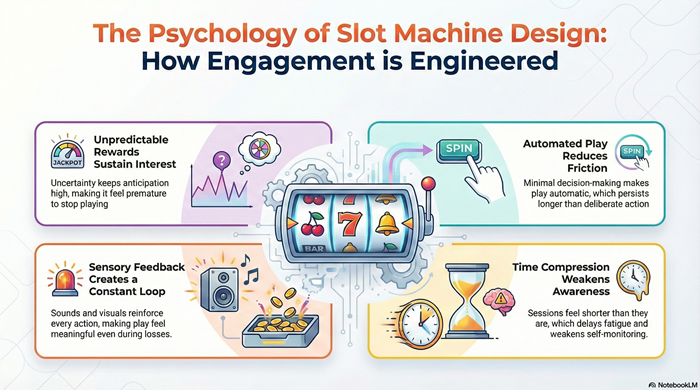
Slot machines often feel patterned because the human brain is exceptionally good at finding order — even when none exists. When players experience repeated losses, near misses, or clusters of similar outcomes, it’s natural to assume the machine is building toward a payout.
This feeling is reinforced by how slot results are displayed. Near misses, repeated symbol groupings, and bonus teases create visual continuity that makes outcomes feel connected. In reality, those outcomes are unrelated. The apparent “pattern” exists only in perception, not in probability.
Slot machines are never “due” for a payout. Random number generators do not track past results, remember losing streaks, or rebalance outcomes over time. A machine that hasn’t paid in a long session is no more likely to pay on the next spin than it was on the first.
Outcomes also do not become more likely after extended losing streaks. Probability does not correct itself in the short term. Each spin is mathematically independent, and prior results have no influence on future ones.
What feels like momentum is simply randomness behaving unevenly — which is exactly how random systems operate. Long losing streaks, sudden wins, and repeated near misses are not signals. They are expected features of probability, not evidence of progression.
This disconnect between how randomness works and how humans interpret it is why slot myths persist. The machine hasn’t changed. Only perception has.
The Illusion of Control in Slot Play
Slots offer:
- Bet size choices
- Line selection
- Feature activation
- Auto-spin
These create engagement, not influence.
Outside of:
- How much you bet
- How fast you lose or win
Players do not control outcomes.
This doesn’t mean slots are unfair — it means they are fully pre-defined systems.
Why Casinos Love Slot Machines
Casinos favor slots because:
- House edge is higher than table games
- No player decisions affect outcomes
- Sessions can run continuously
- Costs are hidden inside entertainment
Slots don’t rely on players making mistakes. The structure already favors the house.
Why Most Slot Advice Is Wrong
Common advice like:
- “Play hot machines”
- “Change slots after losses”
- “Wait for bonuses”
- “Time your spins”
…fails because it assumes the machine reacts.
Slot machines do not react.
Advice that doesn’t account for RNG, RTP, and volatility is storytelling — not strategy.
What Understanding Slot Mechanics Actually Gives You
Understanding how slots work does not help you win.
It helps you:
- Avoid false expectations
- Choose less expensive games
- Recognize risk faster
- Set realistic limits
- Walk away sooner
Knowledge doesn’t beat slots.
It limits damage.
The Honest Reality of Slot Play
Slots are:
- Entertaining
- Random
- Designed for loss over time
There are no systems, timings, or behaviors that reverse this.
What players can control is:
- Game selection
- Session length
- Emotional discipline
That’s it.
Continue Learning About Slot Machines
If you want to understand the mechanics and misconceptions that shape slot play, these guides expand on the key ideas behind how slot machines are designed and experienced:
- What Is RTP in Slot Machines? : Learn how Return to Player is calculated, what it actually represents over millions of spins, and why RTP does not predict short-term wins, streaks, or session outcomes.
- Slot Volatility Explained (Low vs Medium vs High) : Understand how volatility controls payout frequency and win size, why some slots feel steady while others feel brutal, and how volatility shapes player experience without changing the house edge.
- How Slot Odds Are Determined: A clear breakdown of virtual reels, probability weighting, and payout tables — and why slot odds are fixed by design and do not change during play.
- RNG Explained — Are Slots Truly Random?: Learn how random number generators work, why each spin is independent, and why randomness does not make slot machines fair or balanced for players.
- Do Hot and Cold Slots Exist?: An explanation of why slots feel streaky, how randomness naturally creates win and loss clusters, and why past results never influence future spins.
- Can Casinos Change Slot Odds?: Understand the difference between game configuration and real-time operation, when casinos can choose RTP versions, and why odds cannot be adjusted during player sessions.
Slot Machine FAQs
What does RTP mean in slots?
RTP stands for Return to Player — the long-term percentage a slot expects to return over many spins, not a short-term guarantee.
Is each spin independent?
Yes — every spin is independent and determined by the RNG, so past results don’t influence future outcomes. :
Can timing or streaks change outcomes?
No — timing, streaks, or visual patterns do not change the probability of results.
Fairness and Regulation: What Protects Players
All licensed slot machines are tested by independent regulatory bodies. These tests ensure that the random number generator (RNG) works properly, outcomes match the published probabilities, and the stated Return to Player (RTP) is accurate over the long run.
This doesn’t mean the machine will pay more often or that any session is guaranteed to reflect fairness. What it does mean is that the game isn’t manipulated during play, and the odds remain consistent.
Understanding this ensures you know the game is honest—even if it’s not in your favor.
Key Takeaways: How Slot Machines Really Work
- Slot machines use random number generators (RNGs) to determine outcomes instantly and independently on every spin.
- RTP (Return to Player) describes a slot’s long-term cost, not what will happen in a single session.
- Volatility controls how often and how large wins occur, but does not change the house edge.
- Slot odds are fixed by design and do not change based on timing, streaks, or player behavior.
- Slots are never “due” for a win, and past results do not influence future outcomes.
- Visual effects, near misses, and bonus meters affect perception — not probability.
Final Thought: Slots Are Math Wearing Entertainment
Slot machines are not puzzles to solve or machines to read.
They are mathematical engines wrapped in visuals and sound.
Understanding RTP, volatility, and randomness removes mystery — and replaces it with clarity. That clarity doesn’t make slots profitable, but it does make them honest.
Every slot guide that follows builds on this foundation.