
Common Craps Systems Explained—and Why They Fail Mathematically
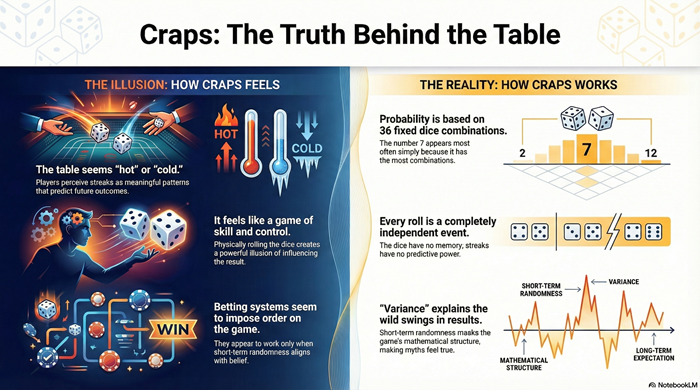
This article is part of our complete guide on How Craps Really Works: Dice Probability, Bets, and Why Myths Persist , which explains craps probability, house edge, variance, and why common myths fail.
What People Mean by “Craps Systems”
A craps system is any structured approach that claims to improve results by reacting to outcomes, sequencing wagers, or exploiting perceived patterns in dice rolls.
These systems are often described as money management strategies, betting progressions, timing methods, or pattern-following approaches.
What they all share is not effectiveness, but assumption.
The Core Assumption Behind All Systems
Every craps system implicitly assumes at least one of the following:
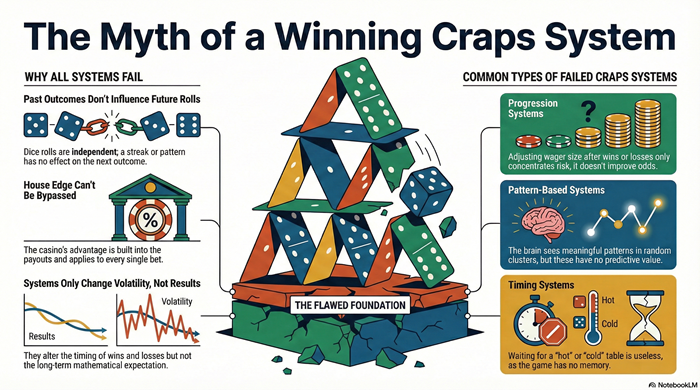
- past outcomes influence future rolls
- probabilities shift over time
- house edge can be bypassed through structure
- variance can be controlled by behavior
All of these assumptions are false.
Systems do not fail because they are poorly designed. They fail because they are applied to a system that does not respond.
Progression Systems: Moving the Risk, Not the Math
How Progressions Are Supposed to Work
Progression systems adjust wager size based on wins, losses, or streak length.
The usual logic is that increasing exposure after losses accelerates recovery, while reducing exposure after wins protects gains.
This approach feels proactive. It feels strategic.
What Actually Changes
Progressions change:
- volatility
- risk concentration
- timing of losses and wins
They do not change:
- outcome probabilities
- payout ratios
- long-run expectation
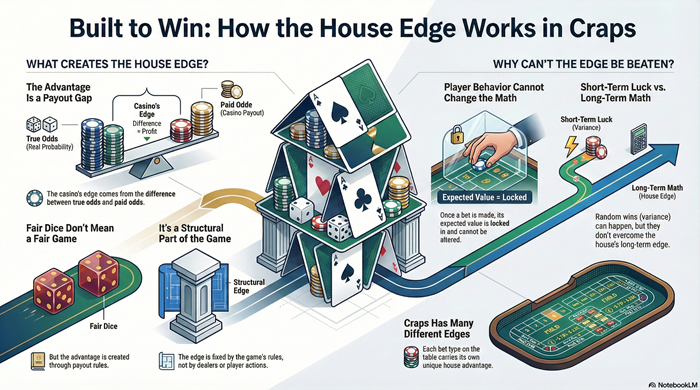
The house edge applies to every unit wagered, regardless of sequence or size.
Rearranging wager order does not rearrange expectation.
Pattern-Based Systems: Mistaking Clusters for Signals
Why Patterns Appear
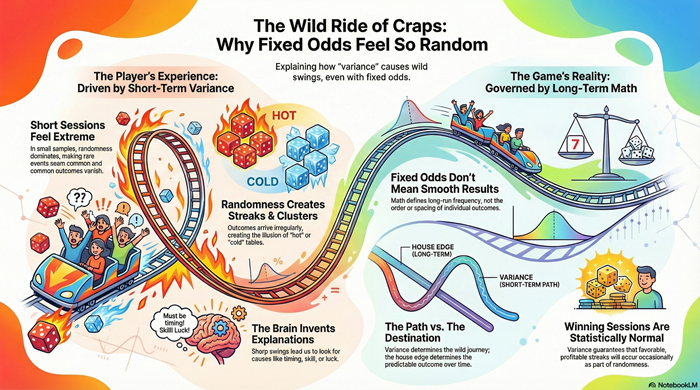
Dice rolls are independent, but random sequences naturally produce clustering.
Repetitions, streaks, and gaps are expected features of randomness, not anomalies.
The brain interprets these clusters as meaningful patterns.
Why Pattern Systems Fail
Pattern-based systems fail because:
- randomness does not self-correct on command
- observed sequences do not influence future outcomes
- by the time a pattern is visible, it already belongs to the past
Reacting to history in a memoryless system has no predictive value.
Timing Systems: Waiting for “Better Conditions”
Some systems rely on waiting—skipping rolls, avoiding “cold” periods, or entering only after perceived shifts.
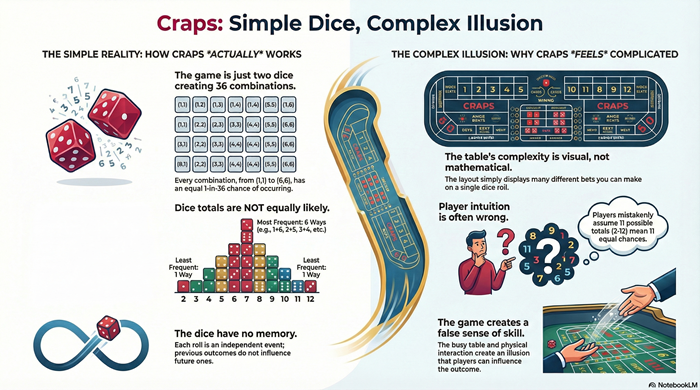
This assumes the game has states.
It does not.
Why Waiting Changes Nothing
If dice rolls are independent:
- waiting does not improve probability
- skipping does not reduce disadvantage
- timing has no effect on expectation
Choosing when to act in a memoryless system does not change outcomes.
Why Systems Sometimes Appear to Work
Short-Term Wins Are Inevitable
In any high-variance game, some players will experience short-term success using almost any method.
This success is unavoidable, not informative.
Variance ensures that favorable sequences occur occasionally.
Survivorship and Outcome Bias
When systems succeed, the wins are remembered and shared.
When they fail, the losses are dismissed, reframed, or attributed to execution errors.
The system receives credit for outcomes variance produced.
Why Failure Rarely Ends Belief
Systems are rarely abandoned after losses because failure is often blamed on:
- poor discipline
- incorrec
Related Pages
- How Craps Really Works: Dice Probability, Bets, and Why Myths Persist
- Why Craps Looks Like a Skill Game (But Isn’t): Complexity, Rituals, and Control Illusions
- Are Dice Rolls Independent in Craps? Why Previous Rolls Don’t Matter
- Variance in Craps: Why Results Swing Wildly Even When Odds Are Fixed
- Myths About Craps That Refuse to Die