
How Sports Betting Really Works: Odds, Expected Value, and Why Parlays Are So Dangerous
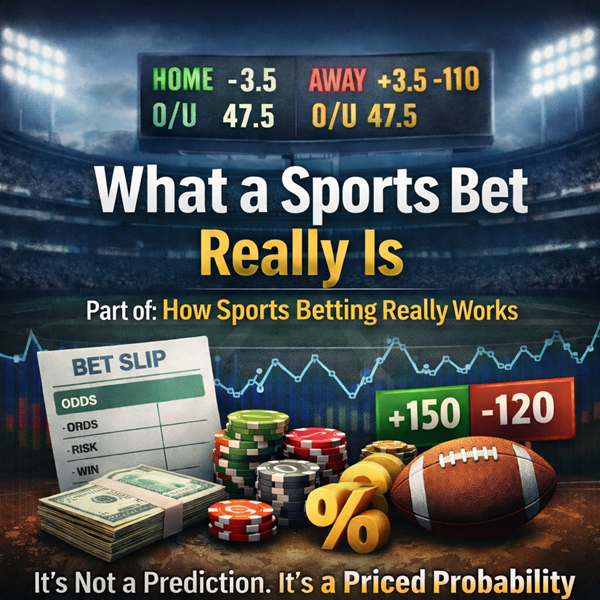
What a Sports Bet Really Is
A sports bet is not a prediction. It is a priced probability.
When a sportsbook offers odds, it is not asking what you think will happen. It is offering a price on an outcome that already reflects an estimated likelihood and includes a built-in margin for the house. The bettor’s belief does not influence that price at the moment the wager is placed.
Most confusion in sports betting comes from treating bets as opinions rather than prices. Bettors naturally focus on whether they are right. Sportsbooks focus on whether a price produces profit over time.
Once this distinction is clear, many common frustrations begin to make sense. Winning does not always mean a good bet was made. Losing does not always mean a mistake occurred. Outcomes are short-term events. Pricing governs long-term results.
For a deeper explanation, see what a sports bet really represents.
How Sportsbooks Price Odds
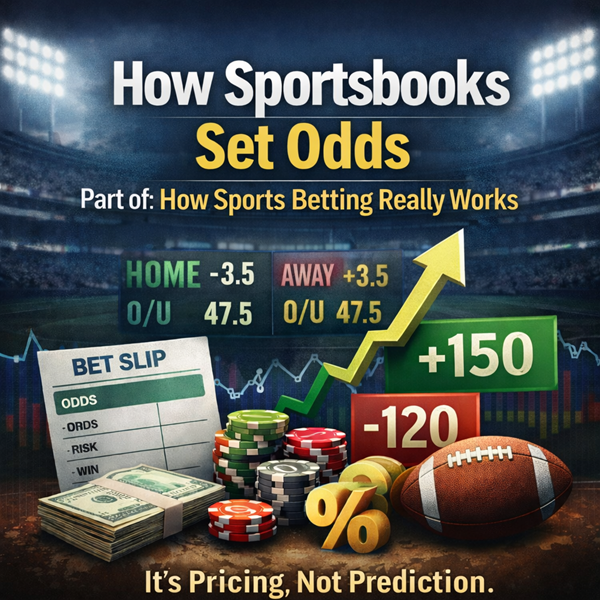
Sportsbooks are often described as predictors, but prediction is not their business model. Pricing risk is.
Odds begin with probability estimates based on historical data, statistical modeling, and situational factors. Those estimates are then adjusted to manage risk, respond to market behavior, and preserve the house margin.
Once odds are posted, they move in response to betting activity rather than hidden insight. Line movement reflects demand, not foresight.
This is why following moving lines does not create an edge. By the time odds shift, the information driving that shift has already been incorporated into the price.
A detailed walkthrough is available in how sportsbooks set odds.
The Vig and the Built-In House Edge
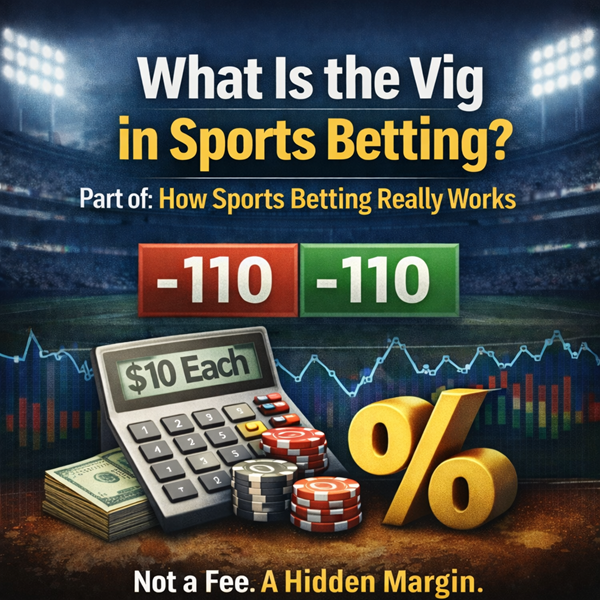
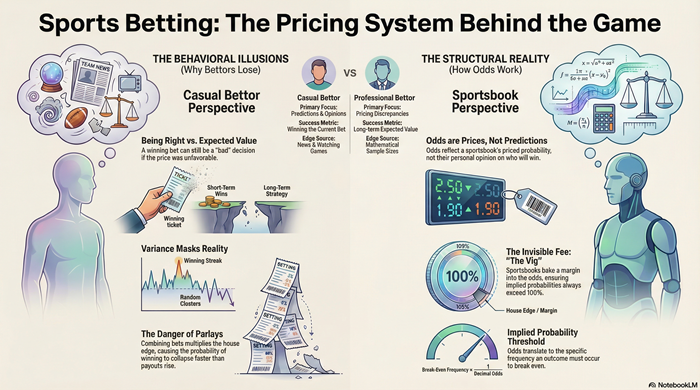
Every sports bet includes a structural cost that works against the bettor. This cost is known as the vig, short for vigorish. The vig is not a penalty applied only when a bet loses. It is embedded into the odds themselves and applies regardless of outcome.
In a perfectly fair betting market, the implied probabilities of all possible outcomes would add up to exactly one hundred percent. In real sports betting markets, they exceed one hundred percent. That excess represents the sportsbook’s margin.
This is why two opposing bets can both appear reasonable while still being unfavorable. Each side is priced slightly below fair value. Over repetition, that small gap accumulates in the sportsbook’s favor.
The vig is easy to overlook because it is not shown as a separate fee. It is distributed invisibly across prices, making each individual bet feel normal and intuitive. Bettors tend to focus on outcomes instead of pricing, which allows the margin to operate quietly in the background.
This structure explains why sportsbooks do not need bettors to be wrong. They only need bettors to accept prices that include a margin. Over time, volume does the rest.
A full explanation of how this margin works is available in the article on the vig in sports betting.
Implied Probability Explained
Odds communicate more than potential payouts. They imply probability.
Implied probability translates odds into the likelihood an outcome must occur in order for a bet to break even. Without making this translation, bets are evaluated emotionally rather than structurally.
Large payouts feel attractive because they suggest opportunity. Small payouts feel safe because they suggest reliability. Implied probability removes this framing and replaces it with a clear threshold: how often does this outcome need to occur to justify its price?
When implied probabilities across all outcomes are calculated, the house edge becomes visible. The total exceeds one hundred percent, revealing the built-in disadvantage faced by bettors regardless of selection.
This perspective helps explain why bettors can feel confident and still lose money. The price may already assume a higher likelihood than reality supports. Confidence does not change that math.
A plain-language breakdown can be found in the guide to implied probability in sports betting.
Expected Value vs Being Right
One of the most persistent misunderstandings in sports betting is the belief that being right is the same as making a good bet.
Expected value governs results over time. It describes the average outcome of a bet if the same price were accepted repeatedly under the same conditions. A bet can win today and still be a losing decision. A bet can lose today and still be correctly priced.
This disconnect explains why short-term results are such poor indicators of betting quality. Wins feel validating even when the price is unfavorable. Losses feel discouraging even when the decision was sound.
Short odds often illustrate this clearly. A heavily favored team may win frequently, yet still offer negative expected value if the price assumes an unrealistically high probability. Over time, that gap asserts itself.
Understanding expected value reframes betting outcomes. Instead of asking whether a prediction was correct, the relevant question becomes whether the price justified the risk.
This concept is explored in depth in the explanation of expected value versus being right.
Variance and Why Short-Term Results Mislead
If expected value governs outcomes over the long run, variance governs almost everything people actually experience while betting.
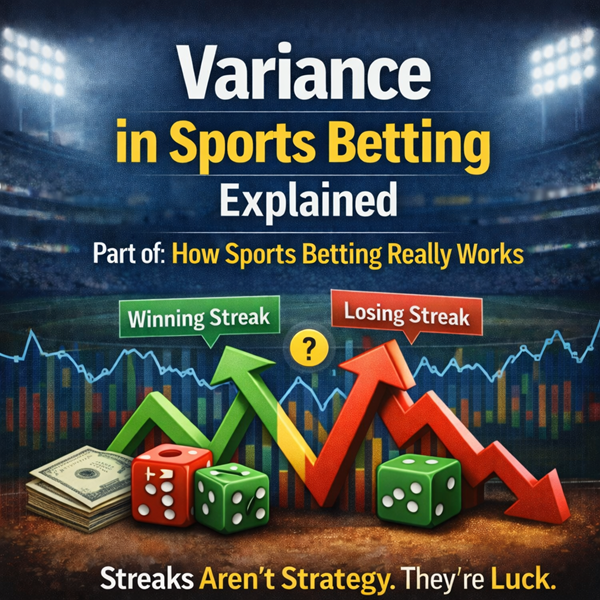
Variance describes how much results can deviate from expectation in the short term. It is not error, manipulation, or unfairness. It is a natural feature of probabilistic systems.
In sports betting, variance produces streaks. Wins cluster together. Losses arrive in runs. Outcomes deviate from expectation for long periods without violating any mathematical rules. This is why betting results feel emotional and personal even when the underlying structure is stable.
Variance is also why losing strategies can appear successful. A bettor may experience early wins, reinforcing confidence and belief. Those wins feel earned because they align with predictions and narratives. Losses that follow are often explained away as unlucky or temporary.
Early success is especially misleading. Variance allows some bettors to win quickly even when their bets have negative expected value. Those bettors are more likely to increase stakes, add complexity, or explore parlays, believing they have found something that works.
This is why short-term results are unreliable indicators of betting quality. Variance masks expectation long enough to sustain belief.
A focused explanation of this effect is available in the article on variance in sports betting.
Why Parlays Feel Smart
Parlays occupy a special place in sports betting. They feel clever, efficient, and strategic. A small wager can produce a large payout, and each individual selection often appears reasonable on its own.
The logic feels sound. If several outcomes are likely, combining them should increase reward without proportionally increasing risk. This mirrors everyday reasoning, where multiple reasonable ideas are treated as reinforcing rather than compounding.
Parlays also feel expressive. They allow bettors to demonstrate understanding across multiple games or markets. A winning parlay feels like confirmation of insight rather than luck.
Small stakes further reduce resistance. Because parlays are often cheap to place, losses feel insignificant in isolation. Wins, when they occur, feel dramatic and memorable.
Variance amplifies this appeal. Long losing streaks feel tolerable. Occasional wins feel extraordinary. This uneven reinforcement keeps bettors engaged even when long-term results are negative.
None of this reflects value. It reflects psychology.
Why Parlays Are Structurally Dangerous
The danger of parlays is not emotional alone. It is mathematical.
Each individual bet includes a margin in favor of the sportsbook. When bets are combined into a parlay, those margins do not disappear. They stack.
Even if every leg appears fairly priced, the combined payout reflects the multiplication of probabilities that already include the vig. The result is a bet with significantly worse expected value than any single component.
This effect compounds quickly. Adding more legs increases payout, but probability collapses faster. The more complex the parlay, the greater the disadvantage.
Same-game parlays often feel smarter because outcomes appear related. In practice, sportsbooks adjust prices to account for correlation. Complexity changes structure, not expectation.
Parlays persist because losses arrive quietly while wins arrive loudly. The cost is distributed across repetition rather than concentrated in any single bet.
A detailed breakdown is available in the explanation of why parlays are so dangerous.
Why Betting Systems Fail
Parlays often appear as part of broader betting systems built around rules, filters, or discipline. The belief is that structure creates control.
Structure does not change pricing.
Systems organize bets. They do not alter expected value. If each bet remains negatively priced, combining them under rules amplifies disadvantage rather than fixing it.
Near misses reinforce belief. Occasional wins reset confidence. Losses arrive slowly enough to avoid clarity.
This is why betting systems tend to fail quietly. There is no obvious collapse point, only gradual erosion.
A deeper explanation can be found in the article on why sports betting systems fail.
Why Information and Research Don’t Create an Edge
Sports betting feels like a knowledge problem. If you research more, watch more games, and follow more news, it feels reasonable to expect better results.
The problem is not that information is useless. The problem is that most information is already priced into the odds.
In modern betting markets, publicly available information is absorbed quickly and efficiently. By the time most bettors act on it, the price already reflects it.
- Injuries, lineups, and weather move odds almost immediately.
- Popular narratives and trends attract action and influence pricing.
- Widely discussed angles become more expensive, not more valuable.
Research often improves understanding of the game without improving the terms of the bet. It makes decisions feel justified rather than profitable.
This creates a powerful illusion. The emotional reward of explanation arrives immediately, while the financial cost of negative pricing arrives slowly.
- Effort feels productive even when expectation remains negative.
- Confidence increases without corresponding value.
- Losses are framed as unlucky rather than structural.
Information is useful for interpretation, not compensation. It explains why lines move and why outcomes surprise, but it does not create an edge by default.
A full discussion is available in the article on why betting research doesn’t create an edge.
Prediction vs Profitability in Sports Betting
One final misconception remains: if betting is so unforgiving, how do professional bettors exist at all?
The answer highlights the most important distinction in sports betting. Prediction and profitability are not the same thing.
Professional betting does not resemble casual wagering. It is not driven by opinions, fandom, or narratives. It is driven by pricing discrepancies and repetition.
- Small advantages applied across large sample sizes.
- Strict focus on price rather than outcome.
- Discipline enforced by structure, not willpower.
Even accurate predictions are meaningless if the odds underpay relative to true probability. Professionals are not trying to be right more often. They are trying to be paid correctly.
Scale matters as much as insight. Without volume, expected value cannot overcome variance.
- Limited capital increases volatility.
- Account limits restrict opportunity.
- Inconsistent pricing access undermines edge.
For most bettors, these conditions do not exist. This is not a failure of intelligence. It is a limitation of environment.
Understanding this distinction resolves much of the confusion surrounding sports betting. It reframes results as structural rather than personal.
A detailed explanation is available in the article on prediction versus profitability in sports betting.
Key Takeaways — Understanding vs Illusion
Sports betting is often misunderstood because it feels familiar. It involves real teams, real players, and real outcomes. That familiarity creates confidence that the math does not support.
At its core, sports betting is a pricing system governed by probability, expected value, and variance.
- Odds are prices, not predictions.
- The vig ensures a structural house edge.
- Short-term results are unreliable indicators.
- Parlays and systems amplify disadvantage.
- Information improves understanding, not expectation.
Understanding how the system works does not remove risk. It removes confusion.
That clarity is the real value of learning how sports betting really works.