
The Dealer Bust Myth Explained: Why “Waiting Them Out” Costs You Money
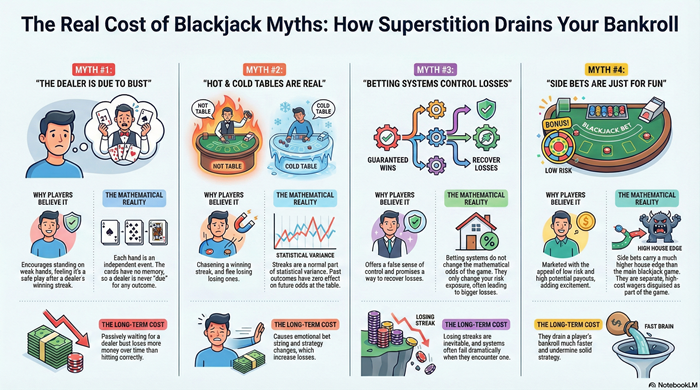
💥Few ideas in blackjack are as comforting as the belief that the dealer will eventually bust if you just stay out of the way. Players repeat it constantly: “Let the dealer bust.” The phrase sounds logical, patient, and disciplined — and it’s one of the most expensive misconceptions in the game.
The dealer does bust. Often. But not often enough to justify passive play on weak hands. As explained in our Blackjack Basic Strategy guide, blackjack is not about hoping for dealer mistakes; it’s about minimizing expected loss through correct decisions. Waiting for a bust when the odds don’t support it quietly increases the house edge.
This article explains where the dealer bust myth comes from, why it feels so convincing, and why relying on it leads players away from optimal strategy.
🧠 What the Dealer Bust Myth Claims
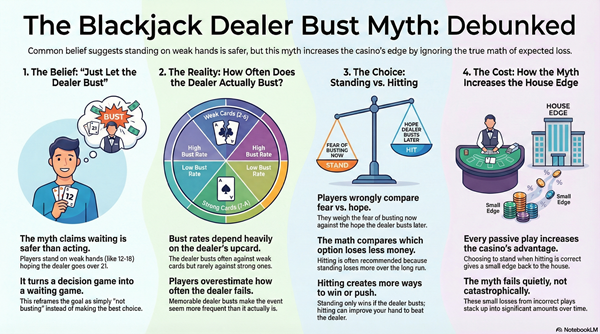
The dealer bust myth is the belief that:
- The dealer will bust often enough to justify standing on weak hands
- Hitting only increases risk unnecessarily
- Patience is safer than action
Players using this logic often stand on:
- Hard 12–16 regardless of dealer upcard
- Marginal totals because “the dealer might break”
- Weak hands simply to avoid busting first
The myth reframes blackjack as a waiting game instead of a decision game.
🎯 Why the Dealer Bust Myth Feels Logical
At first glance, the idea makes sense:
- The dealer must hit until a fixed total
- The dealer cannot stop early
- The dealer busts regularly
Because players see dealer busts, they overestimate how often busting occurs and underestimate how often the dealer survives and wins.
This is a classic case of availability bias — memorable outcomes feel more frequent than they are.
📊 How Often Does the Dealer Actually Bust?
Dealer bust rates vary by:
- Dealer upcard
- Table rules
- Number of decks
Against weak upcards, the dealer does bust more frequently. Against strong upcards, the bust rate drops significantly.
The critical mistake players make is applying average bust rates to specific situations. The dealer busting “sometimes” does not justify standing “always.”
Blackjack strategy already accounts for dealer bust probability — and still recommends hitting in many uncomfortable spots.
🧪 Standing vs Hitting: What Players Get Wrong
When players stand to “let the dealer bust,” they compare:
- The fear of busting immediately
vs - The hope that the dealer fails later
What they don’t compare is expected loss.
Standing on a weak hand often:
- Loses when the dealer makes any reasonable total
- Wins only if the dealer busts
Hitting risks a bust — but also creates outcomes where the player improves enough to win or push.
The math chooses the option that loses less over time, not the option that feels calmer.
⚠️ The Most Expensive Use of the Myth
The dealer bust myth is especially costly when players stand on:
- Hard 16 vs strong dealer cards
- Hard 13–15 against dealer 10s
- Marginal totals simply to avoid embarrassment
These decisions feel prudent. Over time, they cost far more than the occasional bust would have.
Avoiding visible losses does not equal playing well.
🧠 Why Basic Strategy Often Recommends Hitting Instead
Basic strategy recommendations are based on millions of simulated hands. They account for:
- Dealer bust probability
- Player bust probability
- Improvement potential
- Payout structure
When strategy says to hit, it’s because:
- Standing performs worse long-term
- Waiting for a dealer bust is insufficient
- The risk of hitting is justified by the outcomes it creates
The recommendation is not a guess. It’s a conclusion.
🏛️ How Table Rules Influence the Myth
Dealer rules like:
- Hitting or standing on soft 17
- Number of decks
- Surrender availability
…affect bust rates slightly. Players often exaggerate these effects.
Even in dealer-friendly rulesets, the difference is not large enough to justify abandoning correct decisions. The dealer bust myth survives because players notice changes without quantifying them.
📉 How the Dealer Bust Myth Increases the House Edge
Believing the dealer will bust leads to:
- Over-standing on weak hands
- Under-hitting in unfavorable matchups
- Emotional decision-making
- Inconsistent strategy use
Each deviation increases the house edge a little. Over hundreds of hands, those increases stack into meaningful losses.
The myth doesn’t fail catastrophically. It fails quietly.
🧠 Why the Myth Persists Despite Evidence
The dealer bust myth persists because:
- Dealer busts are dramatic and visible
- Correct hits that bust feel embarrassing
- Standing feels “disciplined”
- Losses while standing feel less personal
The myth rewards ego, not math.
📊 Dealer Busts vs Player Busts: The Real Comparison
Players often fear busting more than losing. But a bust and a loss count the same financially.
Blackjack does not penalize how you lose — only that you do.
Strategy treats all losses equally and chooses the path that minimizes them over time, even if that path includes more busts.
📌 What to Replace the Myth With
Instead of asking:
“Will the dealer bust?”
Ask:
“Which decision loses less over time?”
That shift removes emotion and replaces hope with structure. It’s the difference between gambling reactively and playing deliberately.
🔚 Final Thought: Hope Is Not a Strategy
The dealer will bust — sometimes. Just not often enough to save you from passive decisions.
Blackjack rewards players who act when action is required and accept risk when risk is cheaper than waiting.
Letting go of the dealer bust myth doesn’t make the game harsher.
🔗 Recommended Internal Links