
What Slot Players Mean by “Due” (And Why It’s Wrong)
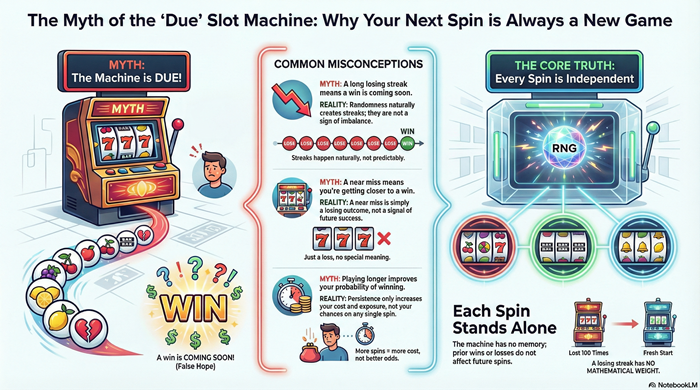
🎰📉 Few words cause more damage in slot play than “due.” Players say it after long losing streaks, after repeated near misses, or when a machine hasn’t paid in a while. “This slot is due,” they say — as if probability is keeping score, waiting to correct itself.
But slots are never due. They don’t track history, compensate for losses, or rebalance outcomes. The belief that they do is one of the most persistent and expensive misunderstandings in gambling. To see why this belief feels so convincing, you have to separate human intuition from mathematical reality. As explained in our guide on how slot machines really work, every slot spin is independent and governed by fixed probabilities, regardless of what came before.
This article explains what players mean when they say a slot is due, why that belief feels logical, and why it is fundamentally wrong.
What Players Mean When They Say “Due”
When players say a slot is due, they usually mean:
- The machine hasn’t paid in a long time
- They’ve experienced many losses in a row
- Near misses keep appearing
- The session feels unbalanced
The underlying assumption is that randomness should “even out” in the short term.
That assumption is false.
The Law of Averages Misunderstanding
The belief in “due” outcomes comes from a misunderstanding of averages.
Players intuitively believe:
- Losses create pressure for wins
- Long streaks require correction
- Balance will restore itself
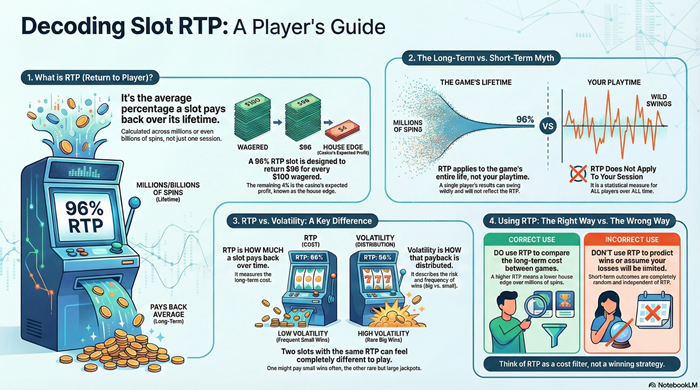
In reality, averages describe long-term behavior, not short-term correction. A slot’s RTP does not force wins to appear after losses. It simply describes expected return over massive numbers of spins.
There is no memory. There is no correction.
Independence: The Core Concept Players Miss
Each slot spin is independent.
That means:
- The machine does not know what happened before
- Prior losses do not affect future spins
- A losing streak has no mathematical weight
A slot that has lost for 100 spins has the same odds on the next spin as it did on the first.
Independence eliminates “due.”
Why Losing Streaks Feel Meaningful
Humans are pattern-seeking.
When we see repeated losses:
- We infer imbalance
- We expect reversal
- We assume a system is drifting
But randomness naturally produces streaks. Long losing streaks are not evidence of malfunction — they are a feature of random distribution.
The brain expects balance. Probability does not.
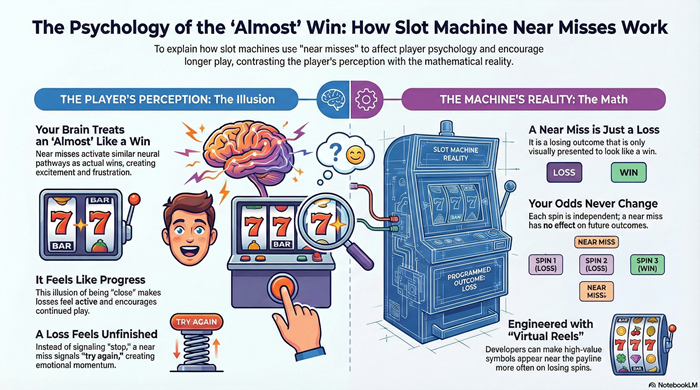
Near Misses Reinforce the “Due” Illusion
Near misses are particularly damaging to rational thinking.
They:
- Suggest proximity
- Mimic almost-success
- Create unresolved tension
Players interpret near misses as evidence that the slot is closing in on a win. In reality, the win outcome was never selected.
Near misses are losing outcomes dressed as information.
Why Jackpot Growth Strengthens “Due” Thinking
Progressive jackpots intensify due-based thinking.
As jackpots grow:
- Attention increases
- Urgency builds
- Belief in inevitability forms
Players assume a large jackpot must eventually be won soon — and that proximity to the moment matters.
But “eventually” has no timetable. The odds remain unchanged no matter how large the jackpot grows.
Persistence Does Not Improve Probability
Playing longer does not create advantage.
Each additional spin:
- Adds cost
- Adds exposure
- Does not add likelihood
Persistence feels productive because effort usually leads to results in real life. In slots, effort only increases volume.
Effort without influence is expensive.
Why “Due” Thinking Survives Despite Losing
“Due” thinking survives because:
- It feels fair
- It explains frustration
- It offers hope
Admitting nothing is changing feels uncomfortable. Believing something must change feels reassuring.
Hope fills the gap where control doesn’t exist.
Casinos Don’t Need “Due” to Be True
Slots don’t rely on players believing in “due” — but they benefit when players do.
Design elements that reinforce due thinking include:
- Near misses
- Frequent small feedback
- Visible jackpots
- Continuous play
These cues don’t create due outcomes. They create due feelings.
Why Rational Knowledge Often Fails in the Moment
Many players know slots aren’t due — until they’re playing.
Emotional immersion:
- Weakens probability reasoning
- Strengthens pattern recognition
- Encourages continuation
Understanding math intellectually is different from applying it during play.
The illusion doesn’t disappear easily.
What Understanding “Due” Actually Changes
Understanding that slots are never due does not:
- Improve odds
- Create winning sessions
What it changes is behavior.
Players who abandon “due” thinking:
- Stop chasing losses
- End sessions sooner
- Make decisions based on limits, not feelings
Removing false expectation restores control.
Continue Learning About Slot Machines
If you want to understand why intuition repeatedly conflicts with probability in slot play, these guides explain the mechanics and psychology behind common player beliefs:
- How Slot Machines Really Work
- Why Slot Jackpots Feel Closer Than They Are
- Why Slot Machines Feel “So Close” Even When Nothing Is Changing
- How Near Misses Manipulate Player Perception
- Why Small Wins Feel Like Progress
- When to Walk Away From Slot Play
- Why Slot Machines Never Feel Finished
Each article explains one reason players feel momentum where none exists.
Final Thought: “Due” Is a Feeling, Not a Signal
Slots don’t owe wins.
They don’t balance losses.
They don’t correct streaks.
“Due” is the brain trying to make randomness feel fair.
The moment you stop waiting for correction is the moment you stop paying for hope.