
Why Slot Machines Feel “Fair” Even When They Aren’t
🎰⚖️ Many players accept slot losses calmly because the game feels fair. Outcomes appear random, rules are disclosed, and payouts are clearly displayed. Compared to table games with visible dealers or opponents, slots seem neutral—almost impartial.
But fairness of process is not the same as fairness of outcome. Slot machines are designed to feel honest and balanced while reliably producing losses over time. To understand why that disconnect exists, you have to separate regulatory fairness from experiential fairness. As explained in our guide on how slot machines really work, slot outcomes are mathematically fixed long before play begins—even when the experience feels transparent.
This article explains why slots feel fair, how regulation reinforces that feeling, and why perceived fairness often masks consistent cost.
What Players Mean When They Say Slots Are “Fair”
When players describe slots as fair, they usually mean:
- Results appear random
- Rules are disclosed
- No decisions seem manipulated
- Everyone plays the same game
This creates trust. Trust reduces resistance.
But none of these qualities address expected value—the single factor that determines long-term cost.
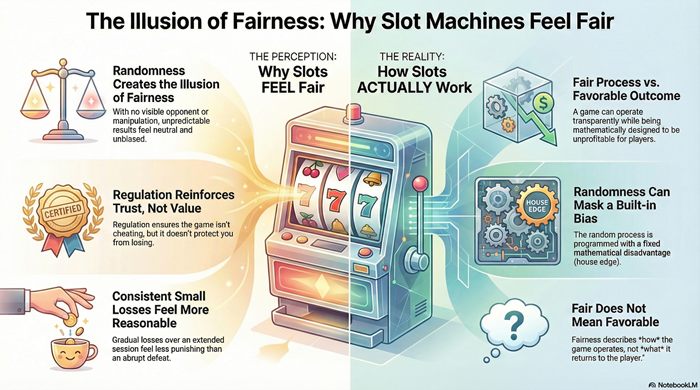
Randomness Creates the Illusion of Fairness
Random outcomes feel fair because they lack visible intent.
There is:
- No opponent
- No decision-maker
- No visible manipulation
When results fluctuate unpredictably, players assume neutrality. In reality, randomness simply masks bias.
A random process can still be consistently unfavorable.
Disclosure Feels Like Protection
Slots disclose:
- Payout tables
- Bonus rules
- Wagering requirements
- General RTP ranges
Disclosure creates legitimacy.
But disclosure doesn’t change expectation. A clearly disclosed disadvantage is still a disadvantage.
Knowing the rules doesn’t make them fair—it makes them transparent.
Regulation Reinforces Trust, Not Value
Regulators ensure that:
- RNGs function correctly
- RTP matches certification
- Outcomes aren’t altered mid-play
This protects players from cheating, not from losing.
A regulated slot is honest about taking money over time. Regulation confirms integrity, not generosity.
Why Consistent Small Losses Feel Reasonable
Slots are engineered to distribute losses gradually.
Instead of:
- Sharp defeats
- Sudden elimination
Players experience:
- Small swings
- Frequent feedback
- Extended sessions
Gradual loss feels fairer than abrupt loss—even if the total cost is higher.
Why Equal Rules Don’t Mean Equal Outcomes
All players face the same probabilities.
This equality creates perceived fairness.
But equal exposure to a negative expectation does not produce equal results—nor does it eliminate disadvantage.
Uniform disadvantage is still disadvantage.
How Volatility Masks Cost
Volatility reshapes experience.
Low-volatility slots:
- Feel steady
- Delay loss awareness
High-volatility slots:
- Offer hope through contrast
- Create memorable wins
Both structures produce loss over time, but neither feels abusive.
Structure controls perception.
Why Players Accept Slot Losses More Easily Than Other Losses
Slots externalize responsibility.
Losses feel:
- Unavoidable
- Impersonal
- Expected
This reduces emotional resistance. When nothing feels “wrong,” stopping feels unnecessary.
Acceptance prolongs exposure.
The Comfort of Blame-Free Loss
Slots allow loss without embarrassment.
There’s no:
- Bad decision to regret
- Opponent to outplay you
- Skill to question
Loss feels natural, not personal.
That emotional comfort is powerful.
Why Fairness Discourages Critical Evaluation
When a game feels fair:
- Players question it less
- Losses are rationalized
- Persistence increases
Unfair-feeling systems provoke scrutiny. Fair-feeling systems invite trust.
Trust lowers defenses.
Fair Does Not Mean Favorable
This distinction matters most.
Slots can be:
- Fairly regulated
- Fairly disclosed
- Fairly random
…and still be consistently expensive.
Fairness describes how the game operates—not what it returns.
What Understanding This Changes
Understanding perceived fairness does not:
- Improve odds
- Create advantage
What it does change is interpretation.
Players who understand fairness illusions:
- Evaluate cost more clearly
- Question comfort-driven persistence
- Set firmer limits
Clarity replaces trust with awareness.
Continue Learning About Slot Machines
If you want to understand why slot machines feel trustworthy despite being mathematically unfavorable, these guides explain the mechanics and psychology behind that perception:
- How Slot Machines Really Work
- What Is RTP in Slot Machines?
- Slot Volatility Explained (Low vs Medium vs High)
- Why Small Wins Feel Like Progress
- How Near Misses Manipulate Player Perception
- Why Slot Sessions Feel Shorter Than They Are
- Why Wagering Requirements Are So Hard to Beat
Each article explains a different reason slot losses feel acceptable—even when they accumulate steadily.
Final Thought: Fairness Is a Feeling, Not a Result
Slot machines feel fair because they are designed to.
They don’t lie, hide, or cheat. They simply present loss in a way that feels balanced, honest, and reasonable.
Understanding that fairness applies to process, not outcome, changes how the game is experienced.
Fair doesn’t mean favorable.
It just means transparent.