
Can Slot Timing Affect Wins?
🎰⏱️ Many slot players believe timing matters. Some wait for certain hours, others watch machines for patterns, and many believe that spinning at the “right moment” increases the chance of a win. These beliefs are reinforced by occasional success that feels too perfectly timed to be random.
But timing only feels meaningful because slot play is fast, emotional, and streaky. To determine whether timing can actually affect slot outcomes, we need to examine how outcomes are generated and whether any moment is statistically different from another. As explained in our guide on how slot machines really work, slot outcomes are created by fixed probabilities applied independently on every spin.
This article explains why timing feels powerful, what players mean by “good timing,” and why no form of timing can influence slot wins.
What Players Mean by “Slot Timing”
When players talk about timing, they usually mean one of several things:
- Spinning after a long losing stretch
- Playing during certain times of day
- Joining a machine after another player leaves
- Delaying or rushing spins
- Playing slower to “let the machine reset”
All of these beliefs assume that when you play matters as much as how the game is designed.
That assumption is the source of the confusion.
Why Timing Feels Important in Casinos
Casinos are environments built around rhythm.
Lights flash, sounds trigger, bonuses erupt, and players come and go. Wins happen suddenly and losses happen quietly. This environment encourages players to connect outcomes to moments.
When a win occurs:
- It stands out
- It feels earned
- It feels connected to the action just taken
The brain naturally tries to explain why that moment produced a result.
In slot play, the explanation is rarely timing.
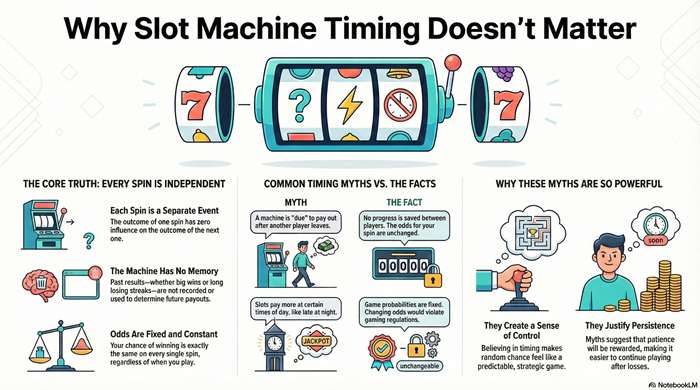
The Independence of Slot Spins
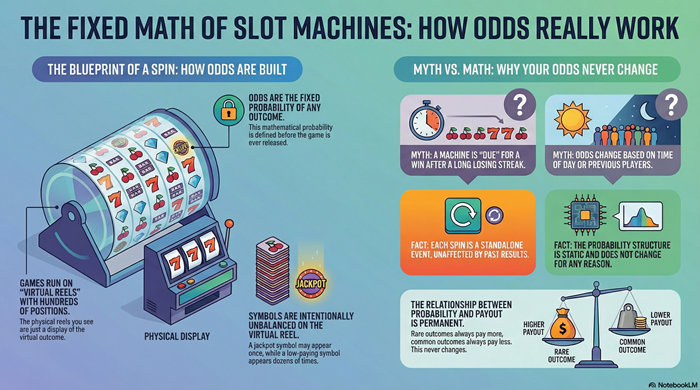
Every slot spin is independent.
This means:
- The outcome of one spin does not affect the next
- The machine has no memory
- The RNG does not “reset” or “cool down”
A spin at 9:00 a.m. has the same odds as a spin at 9:00 p.m. A spin after 100 losses has the same odds as a spin after a jackpot.
Independence removes timing from the equation entirely.
Does Playing After Someone Leaves Matter?
One of the most common timing beliefs is that a machine is more likely to pay after another player leaves.
This belief assumes:
- The previous player “set up” the machine
- Losses accumulate value
- The machine was interrupted before a payout
In reality, when a player leaves:
- No progress is saved
- No odds are adjusted
- No state is carried forward
The next spin is treated exactly the same as every spin before it.
Do Slots Pay More at Certain Times of Day?
Another persistent belief is that slots pay more:
- Late at night
- Early in the morning
- During slow hours
- When the casino wants to attract players
This idea confuses marketing strategy with game mechanics.
Casinos may adjust:
- Promotions
- Bonuses
- Player incentives
They do not adjust:
- Slot odds
- RNG behavior
- Probability weighting
Changing odds by time would violate gaming regulations and undermine certification.
Does Spin Speed Change Outcomes?
Some players slow their spins to “let the machine reset.” Others speed up to catch a window.
Neither approach affects outcomes.
Spin speed influences:
- How quickly money is wagered
- How quickly outcomes are revealed
- How losses or wins are experienced
It does not influence:
- Probability
- RNG selection
- Payout structure
The result is selected the instant you press spin — not while reels are spinning.
Why “Waiting for the Right Moment” Feels Smart
Timing beliefs persist because they provide:
- A sense of control
- A justification for persistence
- An explanation for losses
Waiting for the “right moment” makes continued play feel strategic rather than repetitive.
Unfortunately, feeling strategic is not the same as being correct.
What About Progressive Slots and Timing?
Progressive jackpots add another layer of confusion.
Players may believe:
- A jackpot is due after growing large
- Timing matters as the meter increases
- Someone has to win soon
While the reward grows, the odds do not. The probability of hitting the jackpot remains the same regardless of size.
Timing changes the potential payout — not the likelihood of winning it.
Online Slots vs Casino Slots: Any Timing Difference?
Online slots often feel more timing-sensitive because:
- Spins happen faster
- Outcomes cluster visibly
- Results are displayed instantly
This can amplify the illusion that timing matters.
In reality, both online and land-based slots use the same core principle: independent, random selection within fixed probabilities.
What Actually Controls Slot Outcomes
Slot outcomes are controlled by:
- The RNG
- Probability weighting
- The payout table
They are not controlled by:
- Time
- Player behavior
- Machine usage patterns
- Session history
Once you understand this, timing theories lose their foundation.
Why Timing Myths Are So Hard to Let Go
Timing myths are comforting.
They suggest:
- Losses are temporary
- Wins can be predicted
- Patience will be rewarded
Letting go of these beliefs means accepting that persistence has no memory advantage — and that’s emotionally difficult.
What Understanding Timing Really Changes
Understanding that timing does not matter does not:
- Improve odds
- Increase wins
What it does change is behavior.
Players who stop chasing timing:
- Avoid unnecessary spins
- Stop waiting for signals
- Make cleaner exit decisions
That shift alone can meaningfully reduce losses.
Continue Learning About Slot Machines
If you want to understand why timing feels important — and why it has no effect on outcomes — these guides explain the mechanics that actually govern slot play:
- How Slot Machines Really Work
- What Is RTP in Slot Machines?
- Slot Volatility Explained (Low vs Medium vs High)
- RNG Explained — Are Slots Truly Random?
- Do Hot and Cold Slots Exist?
Each article breaks down one reason why slot outcomes feel reactive even though they are not.
Final Thought: Timing Changes Experience, Not Odds
Slots do not reward patience, observation, or perfect timing.
They reward nothing at all — they execute probabilities.
When you stop waiting for the right moment, you stop chasing meaning where none exists. That doesn’t make slots profitable, but it does make them clearer.
And clarity is the only thing timing can’t provide.