
Why Slot Jackpots Feel Closer Than They Are
🎰🏆 Slot jackpots exert a strange pull. Even players who understand the odds often feel like a jackpot is within reach—as if one more spin, one more session, or one more lucky break could make it happen. Seeing jackpots hit on nearby machines or watching progressive meters climb only intensifies that feeling.
But jackpots don’t get closer through play. They don’t warm up, narrow, or become more likely over time. The feeling of proximity is psychological, not mathematical. To understand why jackpots feel attainable despite astronomical odds, you need to look at how probability is framed and experienced. As explained in our guide on how slot machines really work, slot outcomes are governed by fixed probabilities, not by progress, timing, or persistence.
This article explains why jackpots feel close, how design amplifies that feeling, and why chasing jackpots is one of the most expensive illusions in slot play.
What “Feeling Close” Really Means
When players say a jackpot feels close, they usually mean:
- They’ve seen many high-value symbols
- They’ve experienced near misses
- The jackpot meter looks large
- Someone nearby just won
None of these events change probability. They change salience—how noticeable and emotionally charged the jackpot feels.
Salience is not likelihood.
The Scale Problem: Why Jackpot Odds Are Hard to Grasp
Jackpot odds are often expressed in enormous numbers:
- 1 in 5 million
- 1 in 20 million
- 1 in 100 million
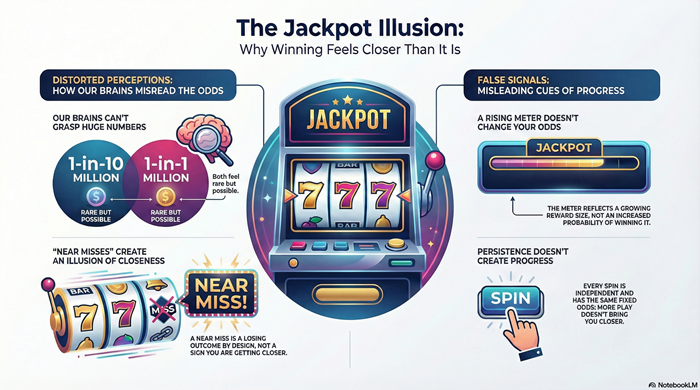
Human intuition isn’t built for scales this large. We instinctively compress them.
To the brain:
- 1 in 1,000,000
- 1 in 10,000,000
both feel like “rare but possible,” even though the difference is tenfold.
When scale collapses, distance feels smaller than it is.
Why Seeing the Jackpot Meter Rise Feels Meaningful
Progressive jackpots visually grow.
As the number increases:
- Attention increases
- Excitement builds
- Urgency forms
But the jackpot amount growing does not change the odds of hitting it.
The meter affects reward size, not probability.
Large numbers feel like momentum. In reality, they represent accumulated losses from many players.
Near Misses Create the Illusion of Proximity
Near misses play a major role in jackpot perception.
Seeing:
- Two jackpot symbols align
- A third just miss the payline
creates the impression that the jackpot was almost triggered.
In truth:
- The jackpot outcome was never selected
- The near miss was a losing outcome by design
- No “distance” was reduced
Near misses simulate closeness without altering odds.
Why Jackpot Winners Distort Perception
Jackpot winners are highly visible.
Casinos:
- Celebrate wins publicly
- Advertise large payouts
- Share stories repeatedly
Losses remain invisible.
This creates availability bias—the brain overweights vivid, memorable events and underweights unseen ones.
Seeing a winner nearby doesn’t mean jackpots are common. It means winners are highlighted.
The Fallacy of “Someone Has to Win Soon”
As jackpots grow, players often believe:
- “It’s due”
- “Someone will win any minute”
- “It might as well be me”
This belief assumes probability responds to time or accumulation.
It does not.
Each spin faces the same odds regardless of how long the jackpot has gone unclaimed.
Persistence Does Not Create Progress
Playing longer does not move you closer to a jackpot.
Each spin:
- Is independent
- Has the same probability
- Does not build toward success
Persistence increases exposure, not proximity.
More spins mean more cost — not more closeness.
Why Jackpot Chasing Feels Rational
Jackpot chasing feels rational because:
- The payoff is large
- The cost per spin feels small
- Stories of success circulate
But small costs repeated thousands of times add up quickly.
What feels like opportunity is often just scale illusion.
Online Jackpots Amplify the Effect
Online slots intensify jackpot perception by:
- Showing global meters
- Updating totals in real time
- Broadcasting wins instantly
Constant feedback reinforces the idea that jackpots are active and attainable, even though the odds remain unchanged.
Visibility increases desire, not probability.
The Role of Volatility in Jackpot Perception
High-volatility slots deepen jackpot illusion.
They produce:
- Long dry spells
- Rare big outcomes
- Strong emotional contrast
This contrast makes jackpots feel like dramatic releases waiting to happen, rather than statistically remote events.
Why Understanding Jackpot Odds Feels Unsatisfying
Understanding that jackpots are extremely unlikely removes excitement.
That discomfort drives people to:
- Ignore the math
- Focus on stories
- Trust feelings
Jackpot play thrives on hope more than calculation.
What Understanding This Illusion Changes
Understanding jackpot perception does not:
- Improve odds
- Create winning strategies
What it changes is expectation.
Players who recognize the illusion:
- Stop chasing meters
- Set firm limits
- Treat jackpots as entertainment, not targets
Awareness short-circuits escalation.
Continue Learning About Slot Machines
If you want to understand why rare events feel reachable — and how perception reshapes probability — these guides explain the mechanics and psychology behind slot play:
- How Slot Machines Really Work
- What Is RTP in Slot Machines?
- Slot Volatility Explained (Low vs Medium vs High)
- How Near Misses Manipulate Player Perception
- Why Small Wins Feel Like Progress
- Why Slot Sessions Feel Shorter Than They Are
- Why Wagering Requirements Are So Hard to Beat
Each article explains one way slot design reshapes how players interpret risk and reward.
Final Thought: Jackpots Aren’t Closer — They’re Louder
Jackpots feel close because they’re constantly highlighted, animated, and celebrated.
But probability doesn’t respond to volume.
A jackpot spin is no closer than it was the moment you sat down. The distance never shrinks — only the feeling changes.
Understanding that doesn’t remove the dream.
It reveals its cost.