
Baccarat House Edge Explained Without Strategy or Systems
This article is part of our complete guide on How Baccarat Really Works: Odds, House Edge, and Why Systems Fail, which explains baccarat odds, house edge, card structure, and why betting systems fail.
This article focuses narrowly on what the house edge in baccarat actually is, where it comes from, and why it remains fixed regardless of betting structure or timing. It does not discuss how to play, how to wager, or how to reduce losses. Its purpose is to explain the mathematics that apply to every hand, independent of player behavior.
What “House Edge” Actually Measures
House edge is a mathematical expression of expected loss over time, stated as a percentage of total money wagered. It describes how a game behaves when repeated under identical conditions across a very large number of hands.
In baccarat, the house edge is not hidden, adjustable, or conditional. It is an outcome of the rules that govern how cards are drawn and how results are paid.
House edge describes:
- Long-run expectation, not short-term results
- Average loss across all qualifying wagers
- A structural property of the game, not player performance
House edge does not describe:
- What will happen in the next hand
- Whether a session will end in profit or loss
- The likelihood of streaks or clusters
Understanding this distinction is critical. House edge applies silently and continuously, even when outcomes appear favorable in the short run.
Why House Edge Is Not a Prediction of Loss
A common misunderstanding is treating house edge as a forecast. It is not. A house edge of any size does not imply that losses will occur evenly or predictably.
In short samples, results are dominated by variance. In long samples, variance smooths out and expectation becomes visible.
This is why baccarat sessions can feel inconsistent while remaining mathematically stable. The house edge is always present, but it does not dictate timing.
How Baccarat’s Rules Create a House Edge
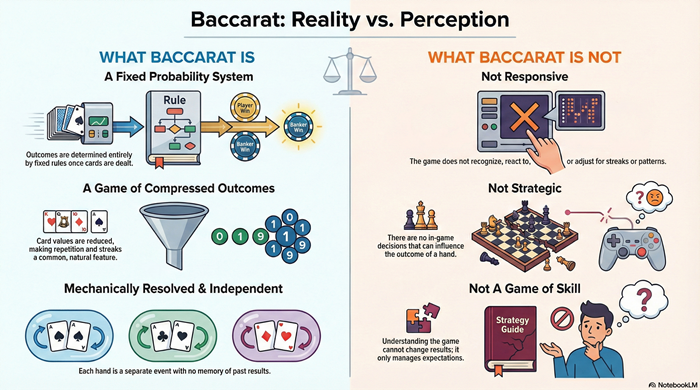
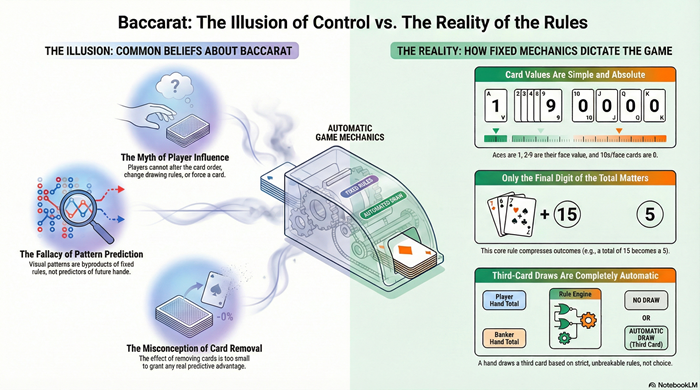
Baccarat differs from many casino games in that players make no meaningful decisions after a wager is placed. Card drawing is fully automated by fixed rules that determine when additional cards are drawn and when hands stand.
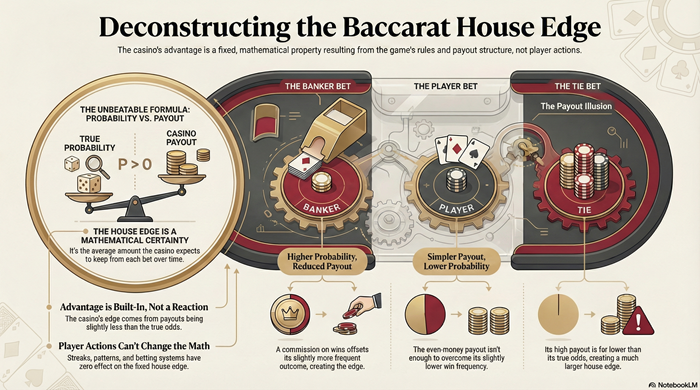
The house edge emerges from the interaction between:
- Fixed drawing rules
- Outcome probabilities created by those rules
- Payout structures assigned to each outcome
No part of this process responds to player behavior. The casino advantage is embedded in the rule set itself.
Why the Game Cannot Be “Adjusted” by the Player
Because players do not influence card drawing, there are no variables to optimize. Changing wager size, sequence, or timing does not affect how cards are dealt or how outcomes are resolved.
As a result, the expected value of each qualifying wager remains constant across hands.
Why Different Outcomes Produce Different House Edges
Baccarat offers multiple possible outcomes that are resolved using the same deck and drawing rules, but they do not share identical payout structures. These differences alone are enough to create different house edges.
From a mathematical perspective, an outcome’s house edge is determined by:
- Its probability of occurring
- Its payout relative to that probability
- Any adjustments applied to winnings
Even small payout deviations accumulate over repeated play. These deviations do not offset one another; they reinforce the casino’s expected advantage.
Payout Ratios vs. True Probability
Payouts in baccarat are designed to feel intuitive, but they are not proportional to probability. Some outcomes pay less than their underlying probability would suggest, while others pay more but occur far less often.
This imbalance is intentional and structural. It ensures that the game remains profitable over time without altering how frequently outcomes appear.
Why Bet Sizing and Systems Cannot Alter House Edge
Betting systems attempt to change results by altering wager size or sequence. Mathematically, this does not change expectation.
House edge remains unchanged because:
- The probability of each outcome does not change
- Expected value scales linearly with wager size
- The order of wagers does not affect distribution
Systems can redistribute losses across time, but they cannot reduce or remove the underlying expectation.
Why “Changing When You Bet” Doesn’t Change the Math
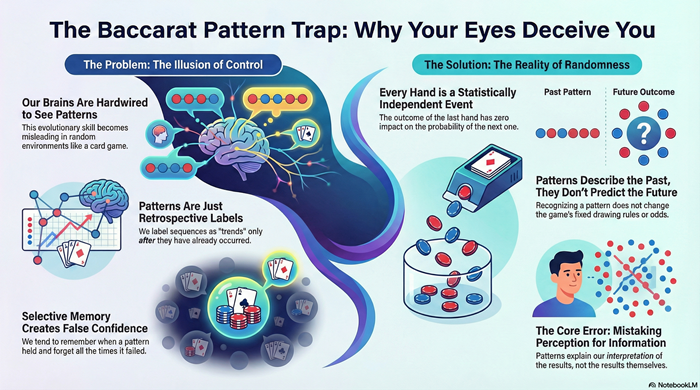
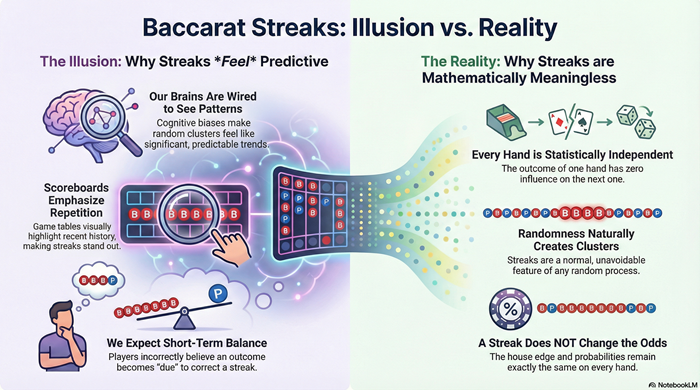
Timing-based approaches assume that probability fluctuates based on recent outcomes. In baccarat, each hand is statistically independent.
Because the house edge applies equally to every qualifying wager, delaying, accelerating, or clustering bets does not change the expected result.
What House Edge Explains — and What It Does Not
House edge explains:
- Why baccarat produces consistent long-term results for the casino
- Why losses emerge gradually rather than immediately
- Why short-term gains do not contradict long-term expectation
House edge does not explain:
- Session-level outcomes
- Streak length or frequency
- Perceived momentum or patterns
Most misconceptions arise from expecting house edge to operate on short time scales. It does not.
Conclusion: The Boundary of the Math
The house edge in baccarat is fixed by design. It is not affected by discipline, structure, or timing. No wagering method can convert a negative expectation into a positive one without changing the rules of the game.
Understanding where the math applies — and where it stops — is essential. Everything beyond that boundary is interpretation, not probability.