
Can Card Counting Work in Baccarat?
This article is part of our complete guide on How Baccarat Really Works: Odds, House Edge, and Why Systems Fail, which explains baccarat odds, house edge, card structure, and why betting systems fail.
This article explains why card counting does not provide a functional advantage in baccarat, how the game’s structure prevents actionable use of card composition information, and why ideas borrowed from other games fail when applied here. It does not discuss counting systems, how to track cards, or how to wager. Its purpose is to explain why the concept breaks down mathematically.
What Card Counting Attempts to Do
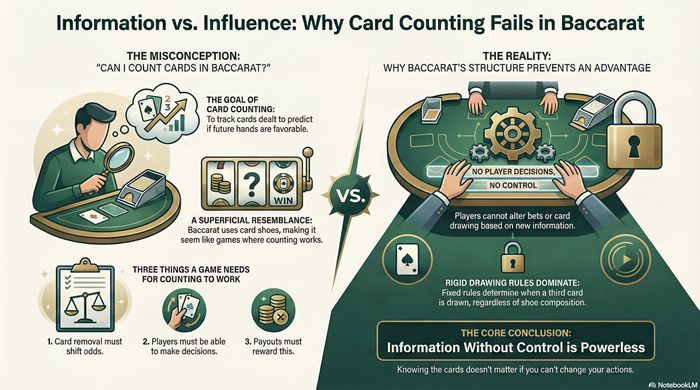
Card counting is a technique intended to track the composition of remaining cards in order to estimate whether future outcomes are more or less favorable than average.
For card counting to be effective, a game must allow:
- Meaningful shifts in probability based on card removal
- Player decisions that can respond to those shifts
- Payout structures that reward selective participation
Baccarat does not meet these conditions.
Why Card Counting Works in Some Games but Not Baccarat
In games where card counting is discussed, the player can change behavior based on information gained from card removal. This requires discretionary choices that affect expected value.
Baccarat differs fundamentally:
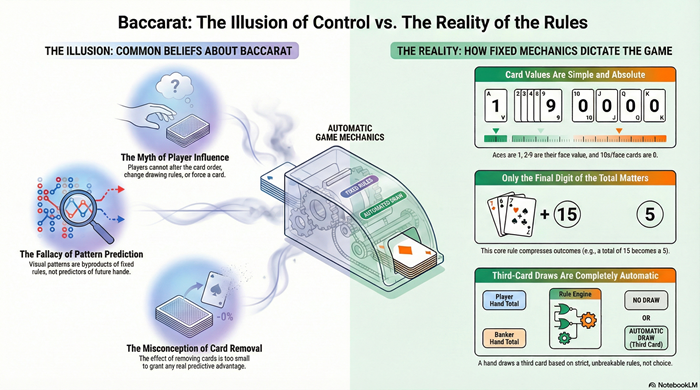
- Players do not control card drawing
- Outcomes are resolved by fixed rules
- No decisions alter how hands are completed
Without decision points, information cannot be converted into leverage.
Value Compression in Baccarat Hand Totals
Baccarat hand values are highly compressed. All cards resolve into a narrow range of final totals, and many different card combinations produce identical results.
Consequences of this compression include:
- Reduced informational value of individual cards
- Dilution of composition effects
- Minimal sensitivity to small distribution changes
Even when card composition shifts slightly, the impact is absorbed by the drawing rules.
Shoe Depletion Does Not Create Usable Signals
As cards are dealt, the remaining composition of the shoe changes. While this is mathematically true, the change does not translate into actionable probability differences.
Reasons shoe depletion does not create usable signals:
- Third-card rules dominate outcome resolution
- Player and Banker outcomes are interdependent
- Probability shifts are small relative to variance
Knowing composition does not permit selective advantage.
Why Fixed Drawing Rules Block Exploitation
In baccarat, once the initial cards are dealt, additional cards are drawn strictly according to preset rules. These rules do not adapt to shoe composition or prior outcomes.
Because of this:
- Favorable compositions cannot be exploited
- Unfavorable compositions cannot be avoided
- Expected value remains stable across hands
The rules enforce consistency at the expense of flexibility.
Why Counting Does Not Change House Edge
House edge in baccarat is created by the interaction of probabilities and payouts. Card counting does not alter payout structure, nor does it allow selective engagement.
As a result:
- Expected value remains negative
- Any temporary deviation is variance
- Long-run expectation is unchanged
Counting cannot overcome a fixed mathematical disadvantage without decision control.
Why Counting Appears Plausible in Baccarat
The idea of card counting persists because baccarat uses physical cards and multi-deck shoes. This creates a superficial resemblance to games where counting is discussed.
However, similarity of materials does not imply similarity of mechanics. Baccarat’s resolution process prevents information from translating into influence.
What Card Counting Explains — and What It Does Not
Card counting explains:
- Why card composition changes over time
- Why players feel informed when tracking cards
Card counting does not explain:
- Advantage creation
- Probability control
- Expected value shifts
Treating observation as influence is the core mistake.
Conclusion: Information Without Control Has No Power
In baccarat, card composition information cannot be acted upon. Without control over outcomes, information does not create advantage.
Card counting fails not because it is poorly executed, but because baccarat’s structure prevents information from altering expectation. The math remains unchanged regardless of observation.