
Why Baccarat Feels Different From Other Casino Games
This article is part of our complete guide on How Baccarat Really Works: Odds, House Edge, and Why Systems Fail, which explains baccarat odds, house edge, card structure, and why betting systems fail.
This article explains why baccarat feels fundamentally different from other casino games at a psychological and structural level, even though its mathematics are straightforward. It does not compare games for advantage, recommend play styles, or suggest preferences. Its purpose is to explain how design, feedback, and perception shape the baccarat experience.
The Absence of Player Decisions
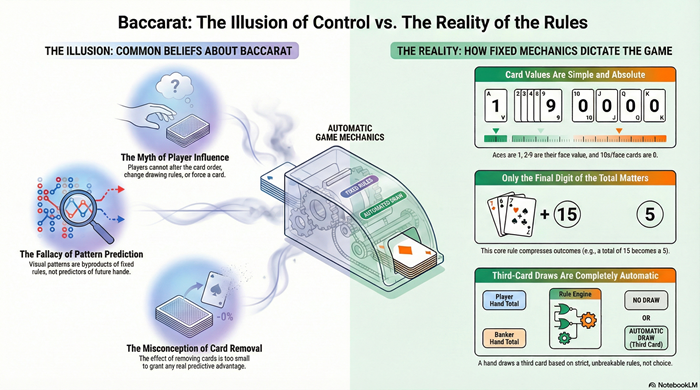
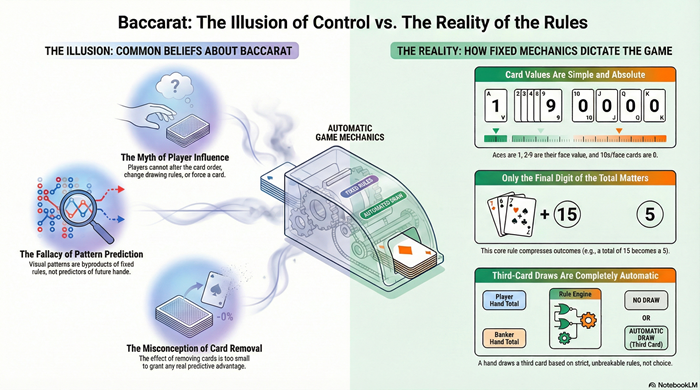
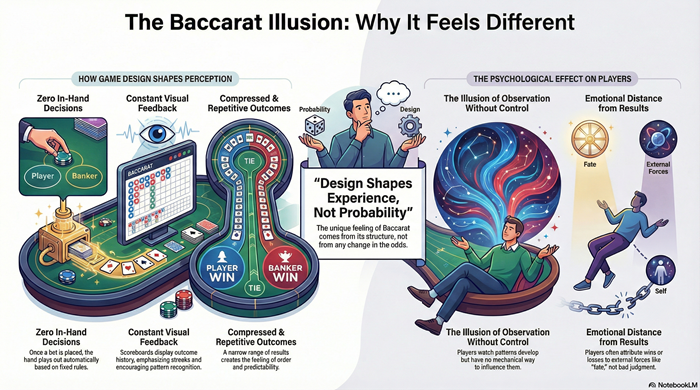
One of the most distinctive features of baccarat is the lack of meaningful player decisions. Once a wager is placed, the hand unfolds automatically according to fixed rules.
This differs from many other casino games where players:
- Make repeated choices
- Adjust actions based on perceived information
- Feel responsible for outcomes
In baccarat, outcomes occur without intervention. This removes decision pressure while preserving emotional engagement.
Fixed Rules and Automatic Resolution
Baccarat hands resolve quickly and consistently. Drawing rules are rigid, non-adaptive, and identical for every hand.
This consistency produces a unique effect:
- Outcomes feel objective
- Responsibility feels externalized
- Results appear inevitable rather than chosen
The game feels less like a test of judgment and more like a reveal of fate.
Compressed Outcomes and Visual Repetition
Baccarat hand totals are compressed into a narrow numerical range. Many different card combinations lead to identical final values.
This compression leads to:
- Frequent repetition of outcomes
- Visually dense scoreboards
- Apparent structure in short sequences
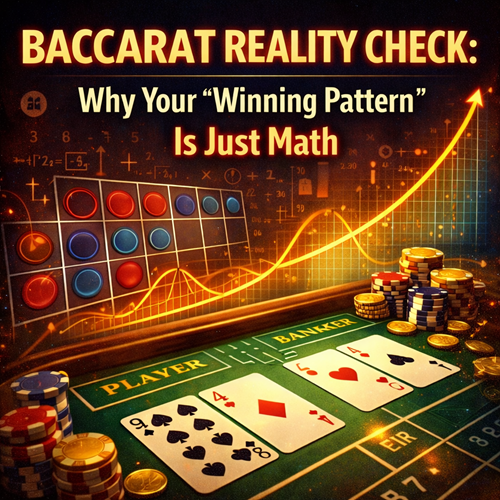
Repetition is not increased predictability, but it feels like order.
Continuous Visual Feedback
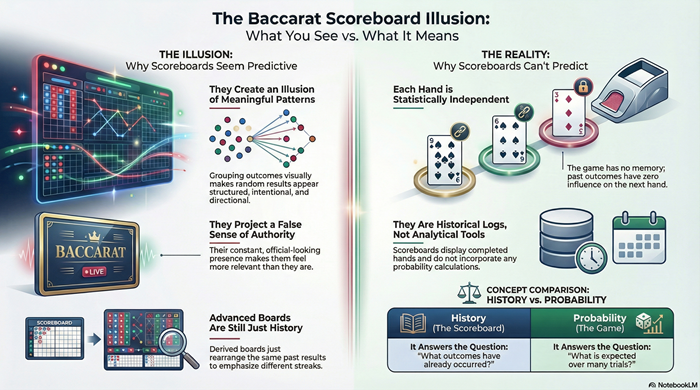
Baccarat tables prominently display outcome history. Multiple boards update in real time, reinforcing attention on recent results.
This visual feedback:
- Emphasizes streaks and clusters
- Encourages narrative interpretation
- Keeps players mentally engaged between hands
Other games often require players to remember history themselves. Baccarat presents it constantly.
The Illusion of Observation Without Control
Baccarat encourages observation without offering influence. Players watch patterns develop but cannot act on them mechanically.
This creates a distinctive tension:
- High informational visibility
- Zero mechanical leverage
- Strong sense of participation
The mind remains active even though the math remains unchanged.
Faster Resolution and Rhythmic Play
Baccarat hands resolve quickly and at a steady pace. There are no pauses for decisions, strategy debates, or calculations.
This rhythm:
- Reduces friction between hands
- Amplifies emotional pacing
- Makes sequences feel continuous
The game feels fluid rather than segmented.
Emotional Distance From Outcomes
Because players do not make decisions during hands, outcomes feel less personal.
Losses and wins are often attributed to:
- The cards
- The shoe
- The sequence
Rather than to judgment errors. This emotional distance changes how results are processed.
Why “Feeling Different” Does Not Mean “Behaving Differently”
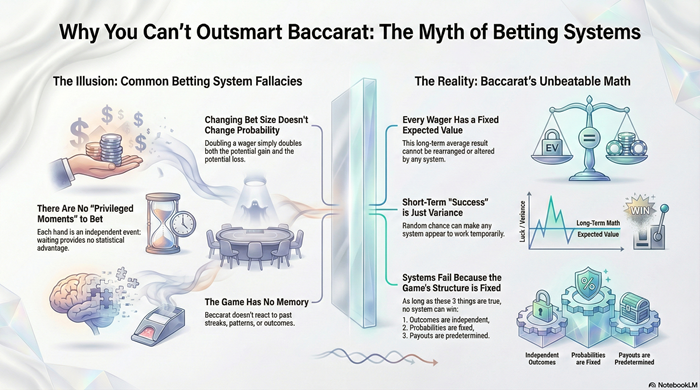
Although baccarat feels distinct, its mathematics do not adapt to perception. Independence, house edge, and probability apply uniformly regardless of presentation.
The feeling arises from:
- Design choices
- Information display
- Cognitive response
Not from altered probability or opportunity.
What the Baccarat Experience Explains — and What It Does Not
Baccarat’s unique feel explains:
- Why players focus on patterns
- Why scoreboards feel important
- Why confidence can grow without control
It does not explain:
- Changes in probability
- Advantage creation
- Predictive insight
Separating experience from mathematics is essential.
Conclusion: Design Shapes Experience, Not Probability
Baccarat feels different because it removes decisions, compresses outcomes, and amplifies visual feedback. These features create engagement without control.
Understanding this distinction helps explain why baccarat attracts strong interpretations while remaining mathematically consistent. The experience is unique, but the probabilities are not.