
Why Baccarat Streaks Appear (And Why They Don’t Matter)
This article is part of our complete guide on How Baccarat Really Works: Odds, House Edge, and Why Systems Fail, which explains baccarat odds, house edge, card structure, and why betting systems fail.
This article explains why streaks are a normal and unavoidable feature of baccarat outcomes, how probability naturally produces clustering, and why those streaks do not alter future results. It does not discuss wagering behavior, betting systems, or how to respond to streaks. Its purpose is to separate visual patterns from mathematical meaning.
What Is Meant by a “Streak” in Baccarat
In baccarat, a streak refers to the repeated appearance of the same outcome over consecutive hands. These sequences are highly visible on scoreboards and are often interpreted as meaningful trends.
Mathematically, a streak is simply a cluster of identical outcomes. It carries no intent, memory, or momentum. It is a descriptive label applied after the fact, not a signal about what comes next.
Why Streaks Are Expected in Random Sequences
Streaks are not anomalies. They are an inherent feature of random processes.
When outcomes are generated repeatedly under stable probabilities:
- Clusters will occur naturally
- Repetition is unavoidable
- Long runs appear without external cause
This behavior is not unique to baccarat. It appears in coin tosses, shuffled cards, and simulated random sequences. The human tendency is to expect alternation, but randomness does not behave that way.
Independence and the Formation of Streaks
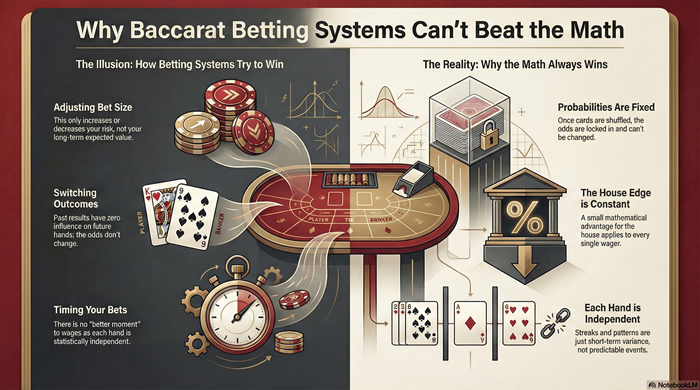
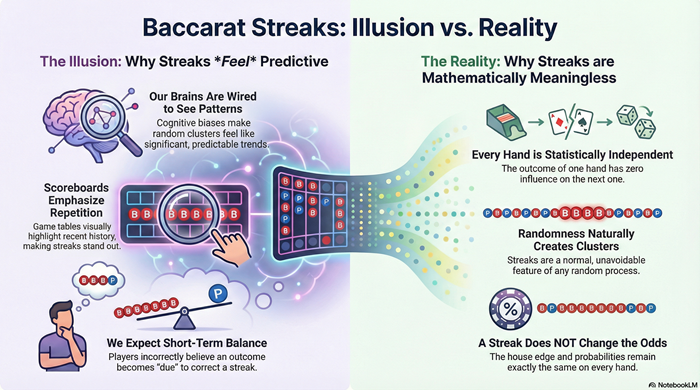
Each baccarat hand is statistically independent. Independence does not prevent streaks—it enables them.
Because each hand is unaffected by prior outcomes:
- There is no balancing force
- No corrective mechanism
- No suppression of repetition
If outcomes were dependent, streaks would actually be less common. Independence allows repetition to occur freely.
Why Streaks Feel Meaningful to Players
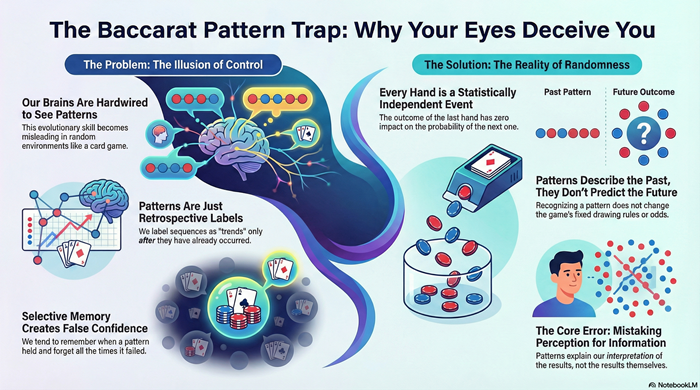
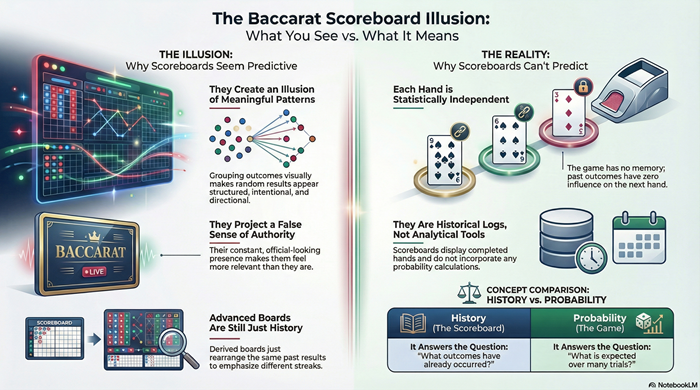
Streaks feel meaningful because they are visually salient and emotionally reinforcing. Baccarat tables emphasize recent history through charts and roads, drawing attention to repetition.
Several cognitive effects contribute to this perception:
- Pattern recognition bias
- Overweighting recent outcomes
- Expectation of short-term balance
These effects make streaks feel predictive even when they are not.
Why Streaks Do Not Change Probability
A critical point: a streak does not alter the probability of the next hand.
After five identical outcomes in a row:
- The probability structure remains the same
- No outcome becomes “due” or “overrepresented”
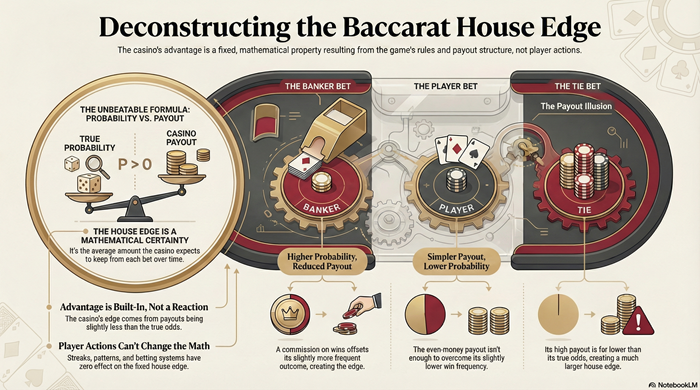
- The house edge is unchanged
Probability does not self-correct on human time scales. Balance appears only across very large samples.
Variance vs. Expectation: Where Confusion Begins
Variance describes short-term fluctuation. Expectation describes long-term average behavior.
Streaks are a product of variance. They do not contradict expectation, nor do they influence it. Confusing the two leads to the belief that streaks contain information.
They do not.
Why Breaking a Streak Is Not a Mathematical Event
The idea of a streak “ending” assumes that the game recognizes the streak. Baccarat does not.
From a mathematical perspective:
- Each hand is a new trial
- No outcome has knowledge of prior frequency
- The next result is resolved independently
What appears to be a break is simply another outcome occurring.
What Streaks Explain — and What They Do Not
Streaks explain:
- Why outcomes cluster visually
- Why scoreboards appear uneven
- Why baccarat sessions feel patterned
Streaks do not explain:
- Future outcomes
- Changes in probability
- Advantage or opportunity
Assigning meaning beyond description is where misconceptions begin.
Conclusion: Streaks Are Normal, Not Informative
Baccarat streaks are not signs of momentum, correction, or imbalance. They are a natural consequence of independent trials under stable probabilities.
Understanding why streaks appear removes their mystique. They matter visually, but not mathematically.