
Why Slot Machines Are Designed to Be Addictive (Without Saying “Addictive”)
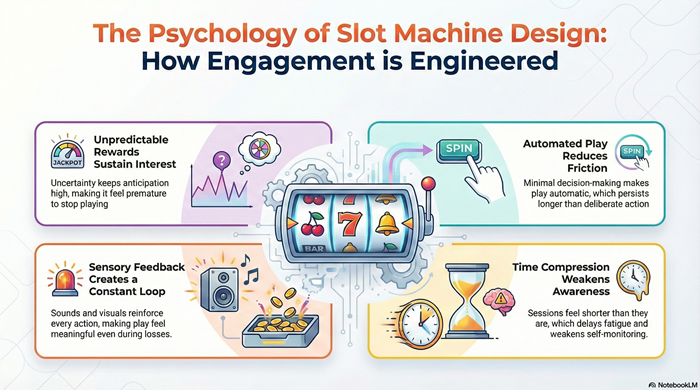
🎰🧩 Slot machines are often described as entertaining, relaxing, or immersive. Players talk about getting “lost in the game” or “zoning out” during sessions. These descriptions aren’t accidental — they reflect how slot machines are intentionally designed to encourage repeated engagement without requiring conscious decision-making.
This doesn’t mean slot machines force behavior or remove free will. It means they are engineered around reinforcement patterns that naturally encourage persistence. To understand why slot play can feel hard to stop, you need to examine how design choices interact with human attention and reward systems. As explained in our guide on how slot machines really work, the math of slots is fixed — but the experience surrounding that math is carefully constructed.
This article explains how slot machines are designed to encourage habitual play, why those design choices are effective, and how they influence behavior without changing odds.
Reinforcement, Not Compulsion
Slot machines don’t rely on force. They rely on reinforcement.
Reinforcement occurs when:
- Actions produce feedback
- Feedback encourages repetition
- Rewards arrive unpredictably
Slots use variable reinforcement, meaning outcomes are uncertain but occasionally rewarding. This pattern is widely known to be effective at sustaining engagement across many activities, from games to apps.
Uncertainty keeps attention active.
Why Unpredictable Rewards Are So Powerful
Predictable rewards get boring.
When outcomes are unpredictable:
- Anticipation remains high
- Engagement stays active
- Stopping feels premature
Slots never reveal when a reward will occur. Each spin carries possibility without commitment.
This uncertainty keeps the brain engaged longer than guaranteed outcomes ever could.
The Role of Continuous Availability
Slots are always available.
There is:
- No cooldown
- No turn-taking
- No waiting
Continuous availability removes natural stopping points. Without interruptions, sessions flow forward by default.
When nothing forces a pause, continuation becomes the path of least resistance.
Why Decision-Making Fades During Play
Slots are designed to minimize decisions.
Once a bet is set:
- The same action repeats
- Feedback replaces choice
- Thinking becomes optional
Reducing decisions reduces friction. When play doesn’t require evaluation, it becomes automatic.
Automatic behavior persists longer than deliberate behavior.
Sensory Feedback and Behavioral Reinforcement
Sound, visuals, and motion reinforce engagement by:
- Marking actions as meaningful
- Signaling progress
- Masking negative outcomes
Feedback loops ensure that almost every action produces a response, even when nothing of value occurs.
Silence would interrupt the loop. Slots avoid silence.
Why Small Rewards Are More Effective Than Large Ones
Slots favor frequent small rewards over rare large ones.
Small rewards:
- Arrive often
- Feel reassuring
- Encourage continuation
Even when these rewards don’t exceed the wager, they maintain emotional momentum.
Momentum sustains sessions.
Near Misses Strengthen Reinforcement
Near misses don’t reward financially — they reward psychologically.
They:
- Signal proximity
- Suggest progress
- Encourage persistence
Near misses make outcomes feel interactive rather than random, reinforcing the urge to continue.
Time Compression Supports Habit Formation
Time distortion makes sessions feel shorter.
When time feels compressed:
- Fatigue is delayed
- Self-monitoring weakens
- Stopping feels unnecessary
Extended engagement becomes comfortable rather than noticeable.
Comfort promotes repetition.
Why Familiarity Increases Engagement
Familiar games feel safer.
Returning to the same slot:
- Reduces uncertainty
- Increases comfort
- Encourages longer sessions
Familiarity lowers resistance and increases trust — even when outcomes remain unchanged.
Regulation Focuses on Fairness, Not Engagement
Regulators ensure:
- Odds are accurate
- RNGs are fair
- Rules are disclosed
They do not regulate:
- Reinforcement intensity
- Sensory feedback
- Session pacing
As long as probabilities are honest, engagement design is allowed.
Why Players Often Say “I Didn’t Mean to Play That Long”
This statement is revealing.
It reflects:
- Reduced time awareness
- Automatic continuation
- Delayed stopping cues
When behavior becomes habitual, intention fades into repetition.
Slots are designed to support that transition smoothly.
What Understanding This Design Actually Changes
Understanding reinforcement design does not:
- Improve odds
- Eliminate risk
What it changes is awareness.
Players who recognize reinforcement patterns:
- Set external limits
- Create pauses intentionally
- Reduce automatic play
Awareness reintroduces choice.
Continue Learning About Slot Machines
If you want to understand how slot machines encourage repeated engagement without changing odds, these guides explain the mechanics and psychology behind modern slot design:
- How Slot Machines Really Work
- Why Slot Sessions Feel Shorter Than They Are
- How Slot Sound and Visuals Influence Player Behavior
- How Near Misses Manipulate Player Perception
- Why Small Wins Feel Like Progress
- Why Wagering Requirements Are So Hard to Beat
- When to Walk Away From Slot Play
Each article explains one reinforcement mechanism that shapes player behavior.
Final Thought: Designed for Engagement, Not Accident
Slot machines don’t rely on deception or force.
They rely on design.
By aligning reinforcement, uncertainty, and comfort, they create environments where continuing feels natural and stopping feels abrupt.
Understanding that doesn’t accuse the game.
It restores perspective.
And perspective is the only reliable counterweight to habit.
📘 Excerpt
This article explains how slot machines are designed to encourage habitual play through reinforcement, uncertainty, and reduced friction—without changing odds or outcomes.
🔗 Suggested URL
/why-slot-machines-encourage-habitual-play/
📊 INFOGRAPHIC PROMPT (FOR NOTEBOOKLM OR DESIGN TOOL)
Use ONLY these sections as source material:
- “Why Unpredictable Rewards Are So Powerful”
- “Why Decision-Making Fades During Play”
- “Time Compression Supports Habit Formation”
- “Sensory Feedback and Behavioral Reinforcement”
Infographic Goal:
Create a clear, educational infographic explaining how slot machines encourage habitual play through reinforcement design. Focus on engagement mechanics rather than medical claims. Keep explanations short, visual, and beginner-friendly. Do not include betting advice, systems, or casino promotions.
Tone: neutral, behavioral, explanatory