
Why the Tie Bet Exists (Game Design Perspective)
This article is part of our complete guide on How Baccarat Really Works: Odds, House Edge, and Why Systems Fail, which explains baccarat odds, house edge, card structure, and why betting systems fail.
This article explains why the Tie outcome exists in baccarat from a game design and mathematical perspective, how it fits into the structure of the game, and why its presence does not alter the underlying probabilities of other outcomes. It does not discuss wagering choices, value comparisons, or betting advice. Its purpose is to explain existence, not usage.
What the Tie Outcome Represents
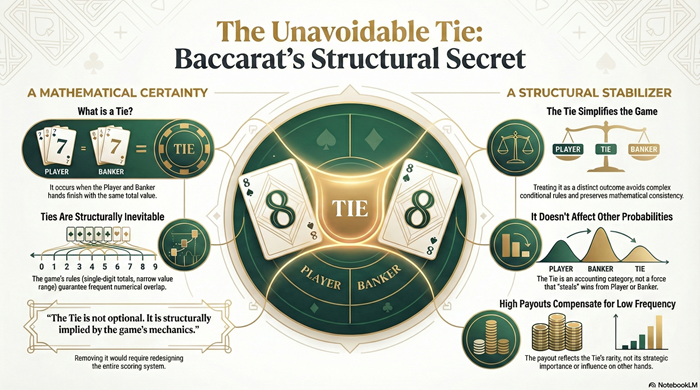
In baccarat, a Tie occurs when the Player and Banker hands finish with the same total. This outcome is not an add-on or exception—it is a direct consequence of how baccarat hand values are constructed.
Because baccarat hand totals are compressed into a small numerical range, equality between hands is unavoidable. The Tie outcome formalizes that equality as a discrete resolution rather than treating it as a reroll or void.
Why the Tie Outcome Is Structurally Inevitable
Baccarat’s card system creates frequent numerical overlap:
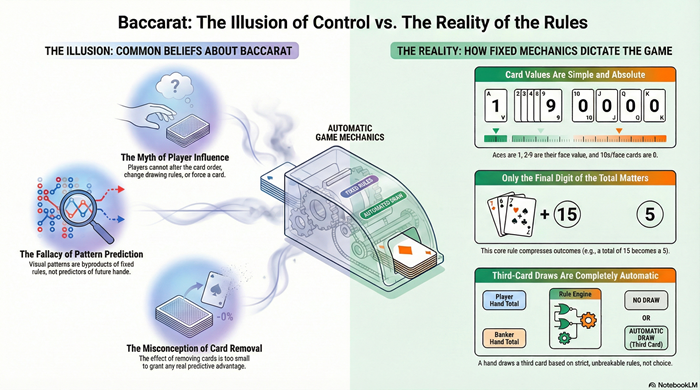
- Only the final digit of totals is used
- All hand values fall within a narrow range
- Drawing rules converge totals toward similar values
Given these constraints, ties are a mathematical certainty. Removing the Tie outcome would require redesigning the scoring system or altering how cards are valued.
The Tie is not optional. It is structurally implied by the game’s mechanics.
Why the Tie Is Treated as a Separate Outcome
From a design standpoint, baccarat resolves outcomes into three mutually exclusive results. This simplifies resolution while preserving mathematical consistency.
Treating a tie as a separate outcome:
- Preserves outcome independence
- Avoids ambiguity in hand resolution
- Allows fixed expectation modeling
Without a distinct Tie outcome, the game would require conditional rules that complicate probability and expectation.
Payout Structure and Game Balance
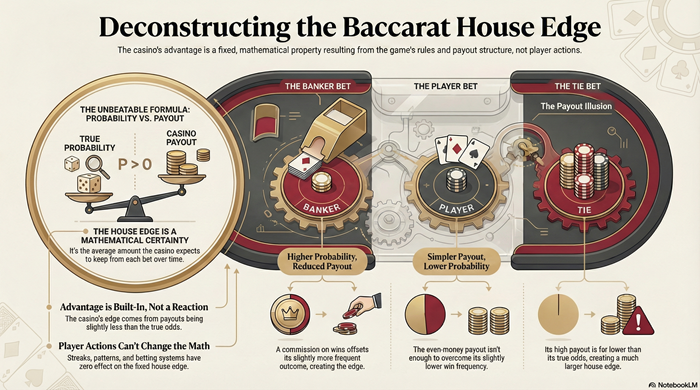
The Tie outcome occurs relatively infrequently compared to Player and Banker results. Its payout structure reflects this rarity rather than its informational value.
From a game design perspective, the payout assigned to Tie serves two functions:
- It compensates for low frequency
- It preserves overall expected value balance
This does not alter the probability of other outcomes. The existence of the Tie bet does not siphon probability from Player or Banker hands.
Why the Tie Does Not Affect Other Probabilities
A common misconception is that Tie outcomes “interfere” with Player or Banker results. In reality, probabilities are calculated across all possible outcomes simultaneously.
Key points:
- The probability of a Tie is independent of payout design
- Player and Banker probabilities remain structurally fixed
- Removing the Tie bet would not change card behavior
The Tie outcome is an accounting category, not an influencing force.
The Role of the Tie in Player Perception
Although this article does not address wagering behavior, it is important to distinguish design purpose from perceived purpose.
The Tie outcome is visually and conceptually distinct, which can make it feel exceptional or special. This perception is psychological, not mathematical.
From the game’s perspective, Tie hands are simply resolved states like any other.
Why the Tie Exists Without Needing to Be Used
Game elements do not require player participation to justify their existence. The Tie outcome exists because the math requires it, not because it must be engaged with.
Baccarat would still function mechanically if the Tie outcome were ignored entirely. Its presence does not enhance or diminish the validity of the other outcomes.
What the Tie Outcome Explains — and What It Does Not
The Tie outcome explains:
- Why identical hand totals are formally resolved
- How outcome space is partitioned cleanly
- Why baccarat probabilities are stable
The Tie outcome does not explain:
- Changes in probability
- Shifts in expectation
- Predictive information about future hands
Misunderstanding its role leads to unnecessary complexity.
Conclusion: The Tie Is a Structural Necessity
The Tie outcome exists because baccarat’s rules make equality unavoidable. It is a structural consequence of card values and drawing rules, not a strategic feature.
Understanding why the Tie exists demystifies one of the most misunderstood elements of the game and reinforces a broader truth: baccarat outcomes are governed by design, not discretion.